Marketing teams often report traffic, impressions, clicks, engagement, and lead volume without clearly showing how these numbers contribute to revenue, profitability, customer retention, or market growth. The problem is not a lack of data. It is the absence of a clear connection between marketing activity and business performance.
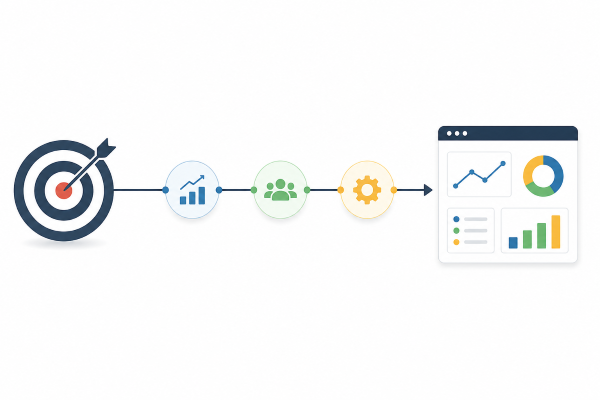
Learning how to translate business goals into marketing KPIs solves this problem. It gives marketers a structured way to move from a broad organizational priority to metrics that guide everyday decisions:
Business goal → marketing contribution → KPI tree → targets → ownership → decisions
This article on amin farahani‘s website explains how to build that connection and create marketing KPIs that are practical, measurable, and aligned with business strategy.
Business Goals, Marketing Objectives, KPIs, and Metrics: What Is the Difference?
Business goals, marketing objectives, KPIs, and metrics are related, but they are not interchangeable. Confusing them often leads teams to select measurements before deciding what outcome they are trying to influence.
A business goal describes what the organization ultimately wants to achieve. A marketing objective defines how marketing will contribute to that goal. A KPI measures whether that contribution is succeeding, while supporting metrics help explain why the KPI is improving or declining.
For a more detailed explanation of KPI definitions and examples, read my guide to what KPIs are in digital marketing.
The Goal-to-Metric Hierarchy
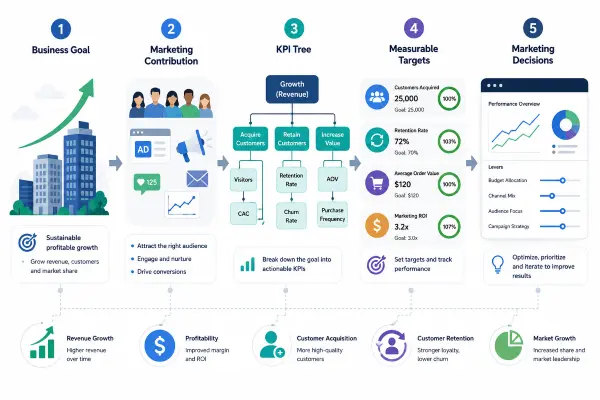
A practical goal-to-metric hierarchy contains five levels:
- Business goal: The final organizational outcome.
- Marketing objective: Marketing’s measurable contribution to the outcome.
- KPI: The critical indicator used to evaluate progress.
- Supporting metric: A diagnostic measurement that explains KPI movement.
- Activity metric: A measurement of work completed by the team.
For example:
- Business goal: Increase annual revenue.
- Marketing objective: Generate more profitable revenue from new customers.
- Primary KPI: New-customer contribution margin.
- Supporting metrics: Qualified leads, conversion rate, customer acquisition cost, and average order value.
- Activity metrics: Campaigns launched, landing pages created, and emails sent.
This hierarchy prevents activity from being mistaken for performance. Launching more campaigns may increase output, but it does not automatically improve business results.
A Six-Step Framework for Translating Business Goals into Marketing KPIs
A useful marketing KPI framework starts with the business outcome and works backward toward the customer behaviors and marketing activities that influence it. The following six-step KPI alignment framework can be applied to ecommerce, SaaS, lead-generation, subscription, and service businesses.
1. Define the Business Outcome Clearly
The first step is to replace vague ambitions with a specific business outcome. Statements such as “grow the business,” “improve marketing,” or “increase awareness” are too broad to support effective business goal measurement.
A useful business goal should include:
- A specific result
- A numerical target
- A timeframe
- A relevant audience, product, or market
- Any important financial condition
Instead of saying, “We want to grow revenue,” a business could define the goal as:
Increase annual revenue from mid-market customers by 20% while maintaining a gross margin of at least 55%.
This definition gives marketing a clear outcome and a financial guardrail. It also makes it easier to identify appropriate marketing performance targets.
The same principle applies to retention, profitability, brand growth, and market expansion. The more clearly the business goal is defined, the easier it becomes to translate business objectives into KPIs.
2. Identify Marketing’s Contribution to the Goal
Marketing rarely controls the entire business outcome. Revenue may also depend on product quality, pricing, inventory, sales performance, customer experience, fulfillment, seasonality, and market conditions.
For that reason, marketing should not be held entirely responsible for a result it can only partially influence. The goal is to identify the customer behavior or commercial driver that marketing can realistically affect.
Ask:
What customer behavior must marketing influence for this business goal to happen?
For a revenue-growth goal, marketing might need to:
- Attract more qualified prospects
- Increase conversion rates
- Improve customer acquisition efficiency
- Increase repeat purchases
- Support expansion into a new segment
- Improve customer lifetime value
Suppose the business wants to increase revenue by €2 million. Marketing may be responsible for generating €1.2 million in qualified pipeline, while the sales team is responsible for converting that pipeline into customers.
This distinction creates better KPI ownership and prevents departments from reporting against goals they cannot control.
3. Build a Marketing KPI Tree
A marketing KPI tree breaks a high-level business result into the drivers that produce it. It creates a visible connection between business goals and marketing KPIs.
For example:
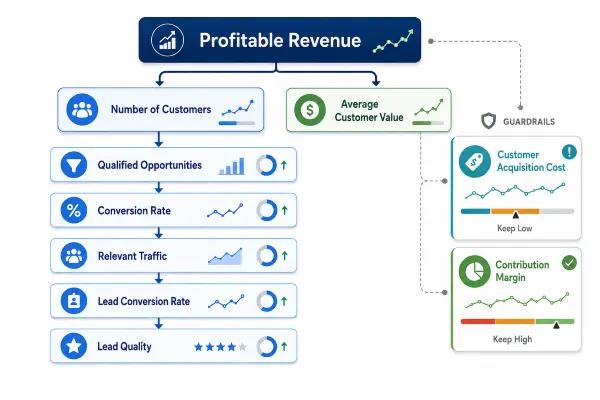
Revenue = Number of customers × Average customer value
The number of new customers can then be broken down further:
New customers = Qualified opportunities × Sales conversion rate
Qualified opportunities may depend on:
Qualified opportunities = Relevant traffic × Lead conversion rate × Lead quality
The top of the tree contains the final outcome. Lower levels contain the leading indicators and controllable marketing levers that influence it.
An ecommerce KPI tree might look like this:
Revenue = Website sessions × Conversion rate × Average order value
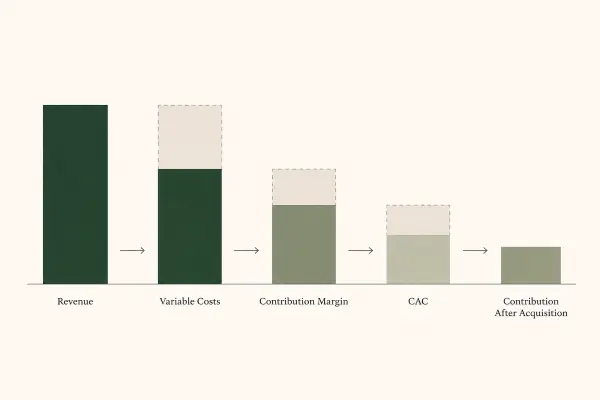
However, revenue alone does not show whether growth is profitable. The business may therefore add customer acquisition cost, contribution margin, or return on ad spend as guardrails.
A KPI tree helps answer an important question: if the final result changes, which driver should the team investigate first?
This is one of the most effective ways to keep marketing KPIs aligned with business strategy rather than reporting isolated platform numbers.
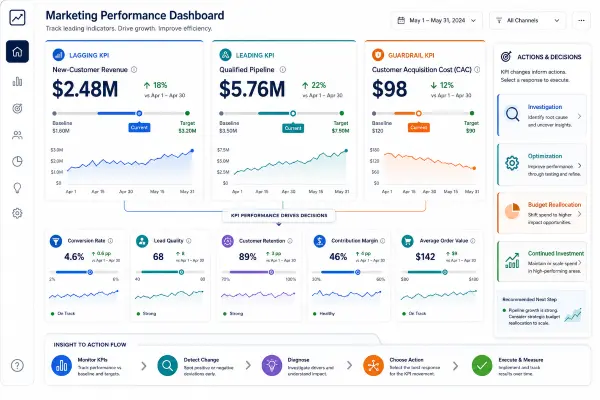
4. Select Lagging, Leading, and Guardrail KPIs
A balanced marketing measurement plan should include lagging, leading, and guardrail indicators.
A lagging KPI confirms whether the final outcome has already occurred. Examples include revenue, profit, customers acquired, churn, and customer lifetime value.
A leading KPI signals whether the business is moving toward that outcome. Examples include qualified pipeline, product-demo bookings, trial activation, branded search growth, and repeat-purchase intent.
A guardrail KPI prevents the team from achieving one result by damaging another important part of the business. Examples include customer acquisition cost, contribution margin, refund rate, lead quality, and unsubscribe rate.
For a customer-growth objective, a balanced KPI set might include:
- Lagging KPI: New-customer revenue
- Leading KPI: Qualified pipeline
- Guardrail KPI: CAC payback period
Leading and lagging KPIs serve different purposes. Lagging indicators evaluate completed results, while leading indicators help the team adjust campaigns before the reporting period is over.
Guardrails are equally important. Without them, a team could increase revenue through excessive discounting, generate more leads by lowering qualification standards, or improve conversion rates by targeting customers with low lifetime value.
5. Turn the Metric into a Defined KPI
A metric becomes an actionable KPI only when it has context. “Conversion rate,” “CAC,” or “qualified leads” are measurements, but they are not complete KPI definitions.
A useful KPI definition template should include:
- KPI name
- Business objective
- Formula
- Current baseline
- Target
- Deadline
- Segment or scope
- Data source
- Responsible owner
- Review frequency
- Action threshold
For example, “increase the conversion rate” is too vague. A properly defined KPI would be:
Increase the demo-to-customer conversion rate from a baseline of 18% to a target of 22% among mid-market leads by the end of Q4.
This definition clarifies the KPI baseline and target, the relevant customer segment, and the deadline.
When deciding how to set KPI targets, teams can use several sources:
- Historical performance
- Current funnel capacity
- Financial forecasts
- Controlled experiments
- Industry benchmarks
- Available budget and resources
Marketing KPI benchmarks can provide context, but they should not replace internal business data. A benchmark from another company may reflect different margins, customer segments, conversion definitions, attribution models, or sales cycles.
Realistic targets should therefore begin with the company’s current baseline and the improvement needed to achieve the business goal.
6. Connect Every KPI to a Decision
The final step is to define what the team will do when a KPI rises, falls, or crosses a threshold.
For example:
- If CAC exceeds the target, review channel allocation, audience quality, and conversion performance.
- If qualified pipeline declines, investigate traffic relevance, landing-page conversion, and lead qualification.
- If revenue increases while contribution margin falls, review discounting and acquisition costs.
- If branded search grows but market conversion remains low, examine positioning, local relevance, and offer-market fit.
A KPI that does not influence a decision is usually just a reporting metric.
This is what makes a marketing KPI actionable: its movement tells the team where to investigate, what to change, or whether to continue investing.
The KPI reporting framework should therefore include not only the result, but also the interpretation, likely drivers, recommended action, and responsible owner.
note: you can read about how to set performance marketing goals in my blog post.
Marketing KPI Examples for Common Business Goals
The right KPIs depend on the business model, customer journey, financial structure, and strategic priority. The following table shows how common business goals can be translated into marketing objectives and balanced KPI sets.
| Business goal | Marketing objective | Primary KPI | Leading indicator | Guardrail KPI |
|---|---|---|---|---|
| Increase profitable revenue | Generate more valuable customer demand | Marketing-sourced contribution margin | Qualified pipeline or purchase intent | Customer acquisition cost |
| Acquire more customers | Increase efficient new-customer acquisition | New customers acquired | Qualified leads or trial activations | CAC payback period |
| Improve retention | Increase repeat purchases or renewals | Retention or renewal rate | Product engagement or repeat-purchase rate | Discount dependency |
| Expand into a new market | Build demand in a defined segment or region | Revenue from the new market | Geographic pipeline or branded search | Market-specific CAC |
| Increase brand awareness | Improve recognition among the target audience | Aided or unaided awareness | Share of search or direct traffic | Cost per target-audience reach |
Revenue Growth and Profitability
Which marketing KPIs support revenue growth depends on whether the business prioritizes total revenue, profitable revenue, or customer value.
Useful KPIs may include marketing-sourced revenue, contribution margin, marketing ROI, average order value, and revenue per customer. Revenue should generally be paired with a profitability guardrail so the team does not create unprofitable growth.
Customer Acquisition and Sales Pipeline
For customer acquisition, relevant KPIs include qualified pipeline, customer acquisition cost, CAC payback period, lead-to-customer conversion rate, and cost per qualified opportunity.
Raw lead volume is rarely sufficient because it does not reflect quality. Generating 1,000 leads is not valuable if very few match the ideal customer profile or progress through the sales process.
Customer Retention and Lifetime Value
Businesses focused on long-term customer value may use retention rate, churn rate, renewal rate, repeat purchase rate, reactivation rate, and customer lifetime value.
Acquisition metrics alone are incomplete when customers leave quickly or never purchase again. Retention KPIs help marketing evaluate whether it is attracting the right customers and supporting long-term value.
Brand Awareness and Market Expansion
Brand and market-expansion KPIs may include aided awareness, share of search, share of voice, branded search growth, direct traffic, geographic pipeline, and conversion rates in the new market.
Impressions, video views, and social engagement may support the analysis, but they should not automatically become primary KPIs. The primary KPI should reflect meaningful change among the intended audience.
Common Mistakes When Aligning Marketing KPIs with Business Goals
Choosing Metrics Because They Are Easy to Measure
Marketing platforms make impressions, clicks, sessions, and engagement rates easy to access. However, availability does not make a metric strategically important.
Begin with the business decision, not the dashboard. The marketing KPI dashboard should display the measurements needed to evaluate progress, rather than every number the available tools can collect.
Using Only Lagging KPIs
Revenue and profit show what has already happened, but they may reveal problems too late for the team to respond.
Leading indicators such as qualified pipeline, trial activation, or repeat-purchase behavior allow marketers to identify changes earlier and adjust campaigns before the final result is affected.
Optimizing One KPI at the Expense of the Business
A team can improve one KPI while damaging overall performance. Increasing lead volume may reduce lead quality, while aggressive discounts may increase revenue but lower contribution margin.
Each primary KPI should therefore be supported by one or two guardrail metrics. This reduces the risk of KPI gaming and keeps marketing activity connected to sustainable business outcomes.
How Often Should Marketing KPIs Be Reviewed?
KPI review cadence should reflect how quickly the measurement changes and how quickly the team can act on it.
Campaign and leading indicators may be reviewed weekly. Funnel performance, acquisition efficiency, and channel results are often reviewed monthly. Strategic outcomes and the relevance of the KPI framework itself should usually be reviewed quarterly.
It is important to separate two different activities:
- Reviewing performance against the KPI
- Reviewing whether the KPI is still appropriate
A team may track a KPI accurately while the underlying business priority has changed. Regular marketing KPI planning ensures that measurements continue to support current strategic objectives.
Final Checklist for Choosing the Right Marketing KPIs
Before adding a KPI to your marketing plan or dashboard, ask:
- Does it connect to a clearly defined business outcome?
- Can marketing materially influence it?
- Does it have a formula, baseline, target, and timeframe?
- Is there a relevant leading indicator?
- Is there a guardrail metric?
- Is the data source reliable?
- Does one person own the KPI?
- Is the review cadence appropriate?
- Will a change in the KPI trigger a decision?
A useful KPI does more than describe marketing activity. It helps the business understand what is happening, why it is happening, and what to do next.
When developing your wider measurement system, connect this framework to The Complete Guide to Performance Marketing Strategy. A clear performance strategy ensures that objectives, channels, budgets, experiments, and KPIs all support the same business direction.