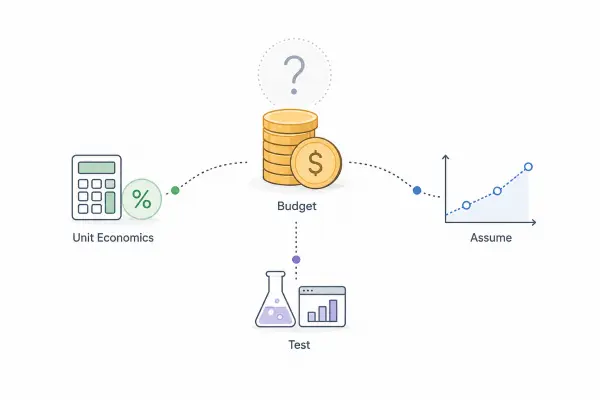
If you have never run a campaign before, you cannot calculate your true customer acquisition cost yet. There is no historical spend and no reliable count of acquired customers. What you can do is estimate CAC well enough to make a budget decision.
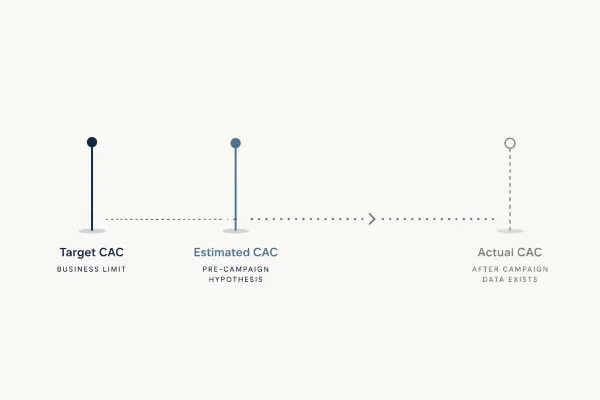
The practical approach is to work with three different numbers: target CAC, estimated CAC, and eventually actual CAC. Your target CAC tells you what the business can afford. Your estimated CAC tells you what the proposed funnel might produce. Actual CAC comes later, once real campaign data exists.
Before we start make sure to read “how to set a marketing budget without historical data”
How to Estimate CAC Before You Have Campaign Data
Once campaigns are running, CAC is straightforward: Actual CAC = Actual acquisition cost ÷ Actual new customers
Before launch, both sides of that equation are uncertain. You may have an estimated media budget, but you do not yet know exactly how many customers that spend will generate. That is why a pre-campaign CAC forecast should be treated as a hypothesis, not a prediction. Instead of asking, “What will my CAC be?” start with two questions:
- What is the maximum CAC my business can afford?
- Based on the channel and funnel, what CAC am I likely to get?
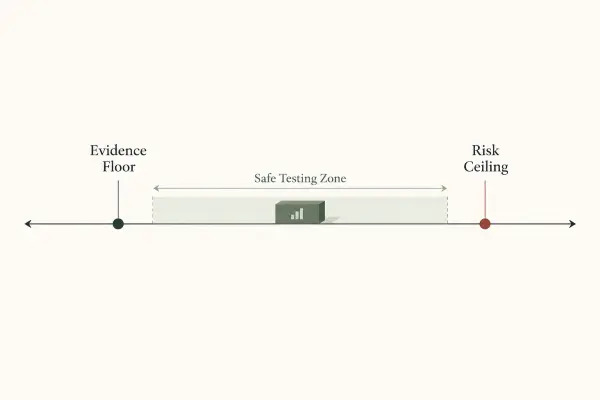
If those numbers are reasonably close, you may have a campaign worth testing. If the expected CAC is far above what the business can support, the problem is visible before you spend the budget.
Step 1 — Set the Maximum CAC Your Business Can Afford
A common mistake is starting with an industry CAC benchmark. Someone finds a report saying companies in their category acquire customers for $200 and puts $200 into the marketing plan. But another company’s CAC says very little about what your business can afford. Your starting point should be the economics of the customer.
Use Contribution Margin When You Don’t Trust Your LTV Yet
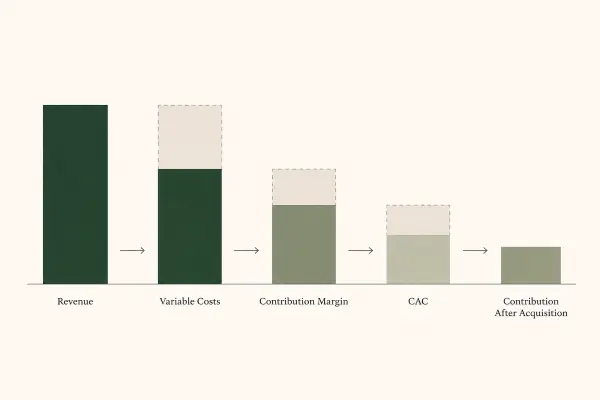
For a new business, lifetime value is often more assumption than data. If you do not know your repeat purchase rate, churn, or retention well enough, building your target CAC around an optimistic LTV can make the whole forecast look healthier than it really is. A safer starting point is the contribution profit you expect from the first purchase or contract. Suppose a customer generates $500 in revenue and leaves $300 after variable costs.
Your break-even CAC might theoretically be close to $300, but spending the full $300 leaves no room for overhead, profit, or forecast error. You might instead set an initial target CAC of $180–$220. That becomes your acquisition guardrail.
Use LTV Carefully When Repeat Revenue Is Predictable
If you already have reasonably reliable retention data or a subscription model with predictable customer behavior, LTV can give you a more useful ceiling. A simple approach is:
Target CAC = Gross-profit LTV ÷ Desired LTV:CAC ratio
If gross-profit LTV is $1,500 and you want an LTV:CAC ratio of 3:1:
$1,500 ÷ 3 = $500 target CAC
The 3:1 ratio is a common planning reference, not a rule. Cash flow, margins, payback period, growth stage, and retention quality all affect how much you should actually be willing to spend. The important point is that your maximum allowable CAC should come from your business model, not from an external benchmark.
Step 2 — Estimate CAC From Channel and Funnel Economics
Now you can model the other side: what the campaign itself might produce. When you have no historical campaign data, your assumptions can come from platform forecasts, similar campaigns, industry benchmarks, comparable landing pages, sales-team close rates, or conservative estimates. None of those inputs is perfectly reliable. That is fine. The objective is to create a reasonable starting model.
For Direct-Purchase Funnels
For a campaign where users can purchase directly after clicking an ad, the model can be quite simple:
Estimated media CAC = CPC ÷ Click-to-customer conversion rate Suppose you expect:
- CPC: $2
- Website purchase conversion rate: 2%
Then:
$2 ÷ 0.02 = $100 estimated media CAC
Another way to think about it: at a 2% conversion rate, you need roughly 50 clicks to acquire one customer. At $2 per click, those clicks cost $100. This is your media CAC, not necessarily your full customer acquisition cost.
For Lead-Generation or B2B Funnels
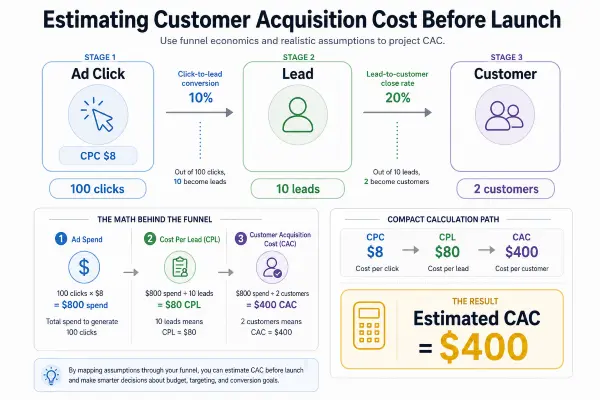
Lead-generation funnels need another step because a lead is not a customer. Suppose you expect:
- CPC: $8
- Click-to-lead conversion rate: 10%
- Lead-to-customer close rate: 20%
The overall click-to-customer rate is:
10% × 20% = 2%
Then:
Estimated CAC = $8 ÷ 0.02 = $400
You can calculate the same thing through CPL. At an $8 CPC and 10% landing-page conversion rate:
CPL = $8 ÷ 10% = $80
If 20% of leads become customers:
CAC = $80 ÷ 20% = $400
This is one of the most useful ways to calculate CAC before launching a campaign because it also shows why CAC might become expensive. Maybe traffic cost is the problem. Maybe the landing page needs an unrealistic conversion rate. Maybe the sales team would need to close 30% of leads for the economics to work. The model exposes those dependencies before the campaign begins.
Don’t Confuse Media CAC With All-In CAC
Paid media spend is only one part of acquisition. Depending on the business, all-in CAC might also include attributable costs such as:
- Creative production
- Agency or freelancer fees
- Marketing labor
- Sales labor
- Sales commissions
- Acquisition software
Do not allocate every company expense into CAC just because it exists. Include costs that are reasonably connected to acquiring customers. If your estimated media CAC is $400 and another $100 per customer is required for sales and marketing operations, your projected all-in CAC is closer to $500. That is the number you should compare against your target CAC.
Step 3 — Build a CAC Range, Not One Forecast
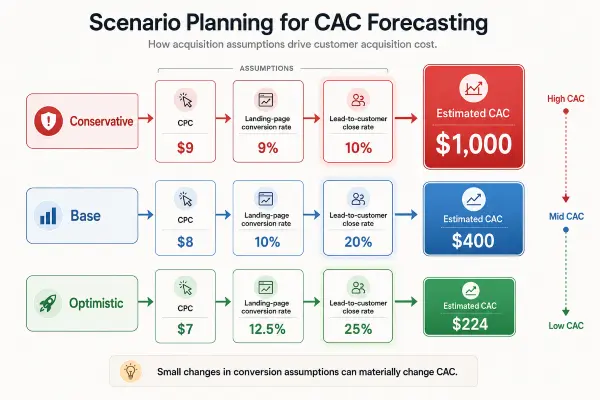
One of the easiest ways to make a bad forecast look credible is to make it too precise. If you have no campaign history, saying your projected CAC will be exactly $437 creates confidence that the underlying data does not justify. Model a range instead.
| Assumption | Conservative | Base | Optimistic |
|---|---|---|---|
| CPC | High | Expected | Low |
| Landing-page CVR | Low | Expected | High |
| Lead close rate | Low | Expected | High |
| Estimated CAC | Highest | Base | Lowest |
For example, assume your base model uses a 20% lead-to-customer close rate. If the real close rate is only 10%, your CAC doubles. That tells you something useful: the close rate is a sensitive assumption, so early campaign evaluation should not focus only on CPC or CPL. You also need enough lead-quality and sales data to see whether the downstream conversion assumption is realistic. This is the real value of a CAC planning model. It does not simply produce a number. It shows you which assumptions need to be validated first.
A Worked Pre-Campaign CAC Example
Imagine a B2B SaaS company preparing its first paid search campaign. Based on its margins and expected customer value, the business has decided that its target CAC is $900. The marketing team estimates:
- Expected CPC: $10
- Click-to-lead conversion rate: 8%
- Lead-to-customer rate: 20%
First, calculate the click-to-customer conversion rate:
8% × 20% = 1.6%
Now calculate estimated media CAC:
$10 ÷ 0.016 = $625
The team also expects roughly $150 per acquired customer in attributable sales, creative, and software costs. So:
Estimated all-in CAC = $625 + $150 = $775
Now compare the two:
Target CAC: $900
Estimated CAC: $775
On paper, the campaign is economically plausible. But the margin of safety is only $125. If the lead-to-customer rate turns out to be 15% rather than 20%, overall click-to-customer conversion becomes:
8% × 15% = 1.2%
Media CAC then rises to roughly:
$10 ÷ 0.012 = $833
Add the same $150 of other acquisition costs and the all-in CAC reaches approximately $983, above the $900 target. That does not automatically mean the campaign is bad. It tells you exactly what the test needs to answer: can the traffic, landing page, and sales process produce enough customer conversion to stay inside the economic limit?
When to Replace the Estimate With Actual CAC
Your pre-launch model should not survive unchanged once real data starts coming in. Replace assumptions progressively:
- Benchmark CPC → Actual CPC
- Assumed conversion rate → Actual conversion rate
- Estimated CPL → Actual CPL
- Assumed close rate → Observed close rate
Eventually, your CAC forecast becomes an actual channel or cohort CAC based on real customers and real acquisition costs. Do not overreact to the first few conversions. One expensive customer or one unusually cheap customer can distort the picture when sample sizes are small. The original estimate was never supposed to predict the final CAC perfectly. Its job was to tell you whether the economics looked plausible enough to justify a controlled test.
If you’re also trying to decide how much marketing budget to commit without historical data, CAC is one of the inputs that connects customer economics to a realistic acquisition budget. The useful mental model is simple: determine what you can afford, model what the funnel is likely to produce, test the assumptions that matter most, and replace estimates with real observations as quickly as the data allows. you can read more about digital marketing on amin farahani‘s webiste.