Performance marketing is often reduced to launching ads, monitoring dashboards, and adjusting bids. But campaign execution is only one part of a successful performance marketing program.
A performance marketing strategy defines how a business will acquire customers profitably, which audiences and channels it will prioritize, how results will be measured, and how insights will guide future investment. It connects business economics with audience research, messaging, channel selection, experimentation, and optimization.
Without this strategic foundation, marketing teams may generate clicks, leads, or conversions without creating sustainable business growth. This guide explains how to build a performance marketing strategy that supports both short-term results and long-term profitability.
What Does a Performance Marketing Strategy Include?
A performance marketing strategy is a structured plan for generating measurable business outcomes through paid and measurable marketing channels. It determines what the business is trying to achieve, how much it can afford to spend, which audiences and channels should be prioritized, and how success will be evaluated.
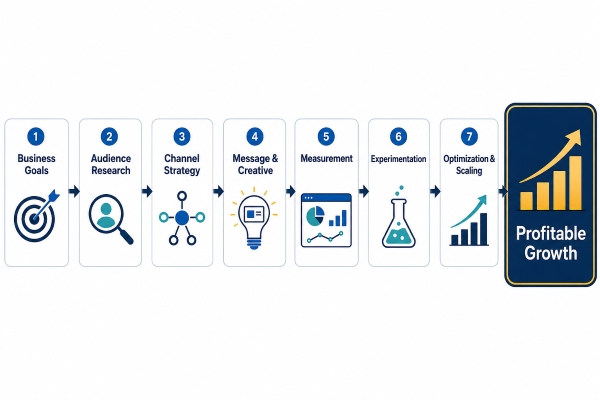
A complete strategy usually includes:
- Business and revenue objectives
- Customer acquisition economics
- Audience and customer journey research
- Channel selection and budget allocation
- Messaging, offer, and creative direction
- Conversion tracking and attribution
- KPI and reporting frameworks
- Experimentation processes
- Optimization and scaling rules
Performance Marketing Strategy vs. Campaign Tactics
Strategy defines the decisions behind the campaigns. Tactics are the actions used to execute those decisions.
For example, launching a Google Search campaign, testing a new Meta ad format, or changing a bidding strategy are tactics. Deciding to prioritize high-intent search demand because it produces better customer quality is a strategic decision.
Tactics may change weekly. Strategy should remain stable until new evidence suggests that the underlying assumptions are no longer valid.
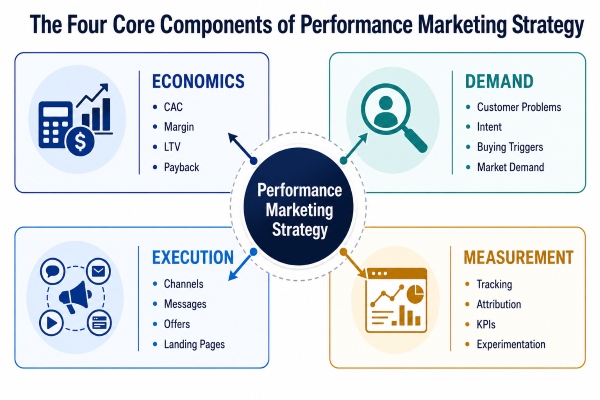
An effective performance marketing strategy connects four areas:
- Economics: What can the business afford to pay for growth?
- Demand: Which audiences have the strongest need and purchase intent?
- Execution: Which channels, messages, offers, and experiences can reach and convert those audiences?
- Measurement: How will the business distinguish real growth from platform-reported performance?
When these components are aligned, campaign optimization becomes more disciplined and scalable.
Step 1: Define Business Goals and Acquisition Economics
Before choosing platforms or campaign types, define the business outcome the strategy must support.
Start with a Business Objective, Not a Platform Metric
Metrics such as impressions, clicks, click-through rate(CTR), and cost per lead(CPL) can help diagnose campaign performance. However, they should not be the primary objective.
Start with a business goal such as:
- Generating a specific amount of profitable revenue
- Acquiring a target number of new customers
- Increasing qualified sales opportunities
- Growing subscription revenue
- Expanding into a new market
- Improving customer acquisition payback
The marketing objective should explain how performance marketing contributes to the broader business goal.
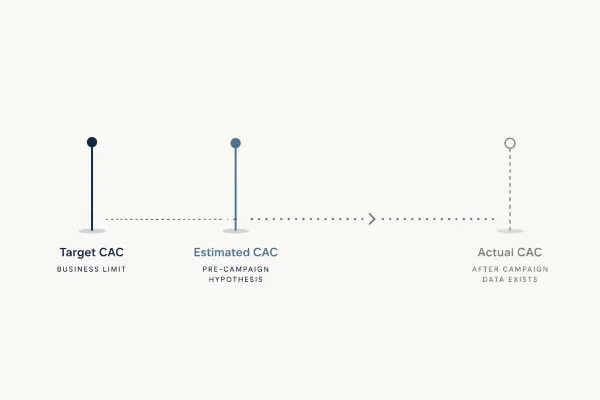
For example, instead of setting a goal to “reduce cost per lead,” define the objective as “generate 300 sales-qualified leads at a maximum customer acquisition cost of $1,500.”
Calculate Your Target CAC, CPA, or Break-Even ROAS
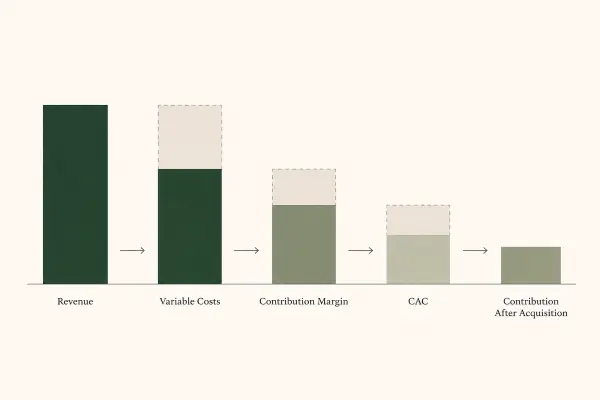
Your acquisition targets must reflect the economics of the business. Customer acquisition cost can be calculated as:
CAC = Total acquisition costs ÷ Number of new customers acquired
For ecommerce businesses, break-even return on ad spend can be estimated using contribution margin:
Break-even ROAS = 1 ÷ Contribution margin
If the contribution margin is 40%, the approximate break-even ROAS is 2.5. However, the business may need a higher target to cover overhead, refunds, discounts, fulfillment costs, and future marketing investment.
Lead-generation businesses should work backward from sales performance. If 10% of qualified leads become customers and the maximum acceptable CAC is $1,000, the maximum qualified-lead CPA would be approximately $100.
Adjust Your Targets to the Business Model
Different business models require different acquisition targets. An ecommerce company may prioritize contribution margin, average order value, repeat purchase rate, and blended ROAS. A SaaS company may focus on customer lifetime value, payback period, activation rate, and churn. A service business may care more about qualified lead rate, sales close rate, and revenue per lead.
Avoid using a universal benchmark. A “good” CPA or ROAS is only good when it supports profitable growth within the economics of the specific business.
Step 2: Understand Your Audience and Customer Journey
Performance improves when audience decisions are based on customer evidence rather than broad demographic assumptions.
Start by understanding why customers begin looking for a solution. Research questions may include:
- What problem are customers trying to solve?
- What event causes them to start searching?
- What alternatives have they already considered?
- What objections delay the purchase?
- What outcomes matter most to them?
- What language do they use to describe the problem?
Useful sources include customer interviews, sales calls, CRM notes, product reviews, support conversations, search queries, social discussions, surveys, and website behavior. The goal is not simply to define who the audience is. It is to understand why they act.
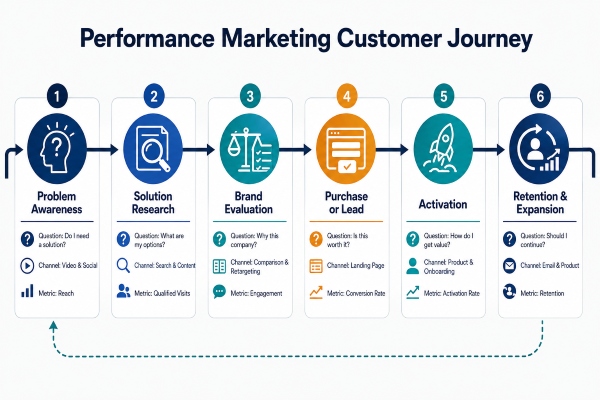
Map the Customer Journey from Awareness to Retention
The customer journey should show the major stages between discovering the problem and becoming a valuable customer.
A typical journey may include:
- Problem awareness
- Solution research
- Brand or product evaluation
- Purchase or lead submission
- Activation or onboarding
- Repeat purchase, retention, or expansion
For each stage, identify the customer’s questions, objections, information needs, preferred channels, and likely next action. This prevents the strategy from treating every user as if they were ready to convert immediately.
Use Customer and Competitor Research to Shape the Strategy
Competitor research can reveal common offers, messaging approaches, landing-page patterns, channel strategies, and market expectations. However, the goal is not to copy competitors blindly.
For example, imagine that 90% of your competitors offer a 40% discount and your target customers are middle-class families. In such a market, you may need to offer a similar discount to remain competitive. If you cannot, you may need to negotiate better terms with your suppliers, reduce costs, or reconsider your positioning.
You should also recognize that many middle-class families are highly price-sensitive and actively look for discounts in their everyday shopping, especially in countries with lower GDP per capita.
Step 3: Build a Performance Marketing KPI Framework
A KPI framework connects campaign activity to business performance. First select your North Star Metric, it should represent the primary outcome the strategy is expected to influence. Depending on the business, this may be:
- New customer revenue
- Contribution profit
- Qualified pipeline
- New subscriptions
- Activated customers
- Customer lifetime value to CAC ratio
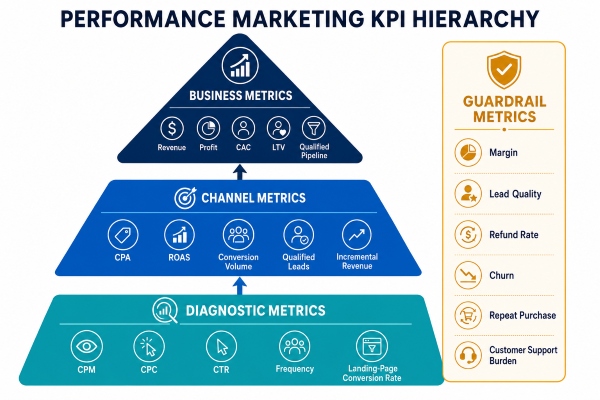
At the same time, you need to organize metrics into three levels: Business level, Channel level, Diagnostic level.
The first and the most important level measure commercial impact, including revenue, profit, CAC and … . Business level metrics can become your north star metric. Channel metrics measure the performance of specific acquisition sources, including CPA, ROAS, conversion volume, cost per qualified lead, and incremental revenue. Diagnostic metrics explain why results are changing. These include CPM, click-through rate, cost per click, landing-page conversion rate, impression share, frequency, and video completion rate.
A drop in ROAS, for example, may be caused by higher media costs, lower click quality, creative fatigue, weaker conversion rates, or changes in average order value. Diagnostic metrics help identify the cause, Based on these metrics you start to optimising your campaigns.
Sometimes, Optimizing one metric can damage another. Let me explain : A campaign may lower cost per lead while generating low-quality inquiries. A discount may improve conversion rate while reducing contribution margin. A broad audience may increase revenue while producing customers with weak retention. Guardrail metrics can include:
- Refund or cancellation rate
- Lead-to-opportunity rate
- Sales close rate
- Gross margin
- Churn
- Fraud rate
- Repeat purchase rate
- Customer support burden
Step 4: Select the Right Performance Marketing Channels
Channel selection should be based on strategic fit rather than popularity. You must Evaluate Channels Based on Intent, Audience, Budget, and Scalability; Assess each channel using four questions:
- Intent: Are users actively searching for a solution, or must demand be created?
- Audience: Can the platform reliably reach the target customer?
- Budget: Is there enough investment to generate meaningful data?
- Scalability: Can spend increase without acquisition costs becoming unsustainable?
Google Search can be effective for capturing existing demand. Paid social can help generate awareness and reach audiences before they begin searching. Affiliate marketing can extend distribution. Marketplaces can provide access to high-intent shoppers. Programmatic, influencer, video, and native advertising may support broader reach or consideration. No channel is inherently best. The right channel is the one that matches the customer journey and business economics and your product. After channel selection you need to Define Primary, Supporting, and Experimental Channels.
Instead of treating every channel equally, assign each one a role.
- Primary channels receive most of the budget because they have the strongest evidence of profitable acquisition.
- Supporting channels assist the customer journey through activities such as retargeting, education, demand generation, or brand reinforcement.
- Experimental channels receive controlled budgets to test new growth opportunities.
This structure helps protect proven revenue while maintaining a pipeline of future opportunities.
Channels should work together rather than operate as isolated campaigns. A customer may first encounter a video ad, later search for the brand, visit a comparison page, receive a retargeting ad, and finally convert through email or direct traffic. The strategy should define the role of each channel across awareness, consideration, conversion, and retention.
Note : Avoid Spreading Your Budget Across Too Many Channels
Running many channels with limited budgets often produces incomplete tests. Each platform receives too little spend to generate sufficient conversions, making optimization and interpretation difficult. It is usually better to validate a small number of channels before expanding. Concentrated investment creates clearer learning and stronger operational focus.
Step 5: Set and Allocate Your Performance Marketing Budget
A performance marketing budget should reflect both business ambition and realistic acquisition capacity. There are many ways to allocate your budget one of them is Top-Down method. Top-down planning begins with the business target. For example, if the goal is to acquire 500 customers at a target CAC of $200, the initial acquisition budget would be approximately $100,000.
Bottom-up planning estimates what each channel can realistically deliver based on search volume, audience size, expected CPMs, conversion rates, historical performance, and operational capacity.
Compare the two approaches. If the business target requires more volume than available channels can reasonably provide, the strategy must address the gap through better conversion rates, new channels, stronger offers, or revised expectations.
Separate Core Campaign, Retargeting, and Testing Budgets
In most cases you need to divide your budget into three parts and separating these budgets prevents short-term performance pressure from eliminating experimentation.
- Core campaigns support proven customer acquisition.
- Retargeting budgets re-engage qualified users.
- Testing budgets fund new audiences, creatives, offers, platforms, and landing pages
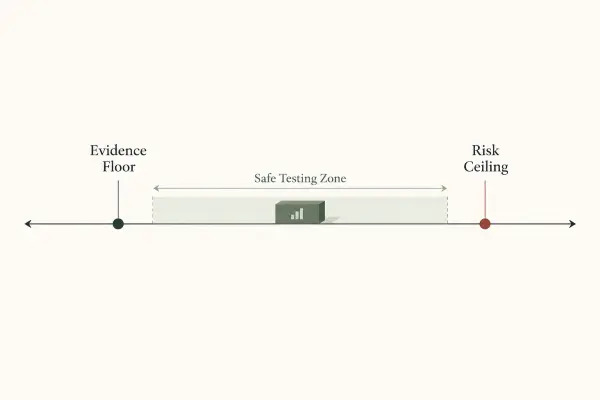
Note : A test needs enough budget to produce a meaningful number of conversions. The required amount depends on the expected CPA, sales cycle, traffic costs, and statistical uncertainty. A campaign expected to generate conversions at $100 CPA cannot be evaluated fairly after spending only $150.The objective is not always statistical significance. However, the test should generate enough evidence to support a business decision.
Step 6: Develop Your Message, Offer, and Creative Strategy
Strong targeting cannot compensate for weak messaging. The strategy must define what the business will communicate and why the audience should respond.
The value proposition should explain:
- Who the product is for
- What problem it solves
- What outcome it creates
- Why it is different
- Why the customer should act now
The offer translates that value into a specific reason to convert. It may include a trial, consultation, demonstration, discount, guarantee, assessment, bundle, or other incentive. The strongest offer is not necessarily the largest discount (This part based on the economy). It is the offer that reduces the customer’s perceived risk and makes the next step feel worthwhile.
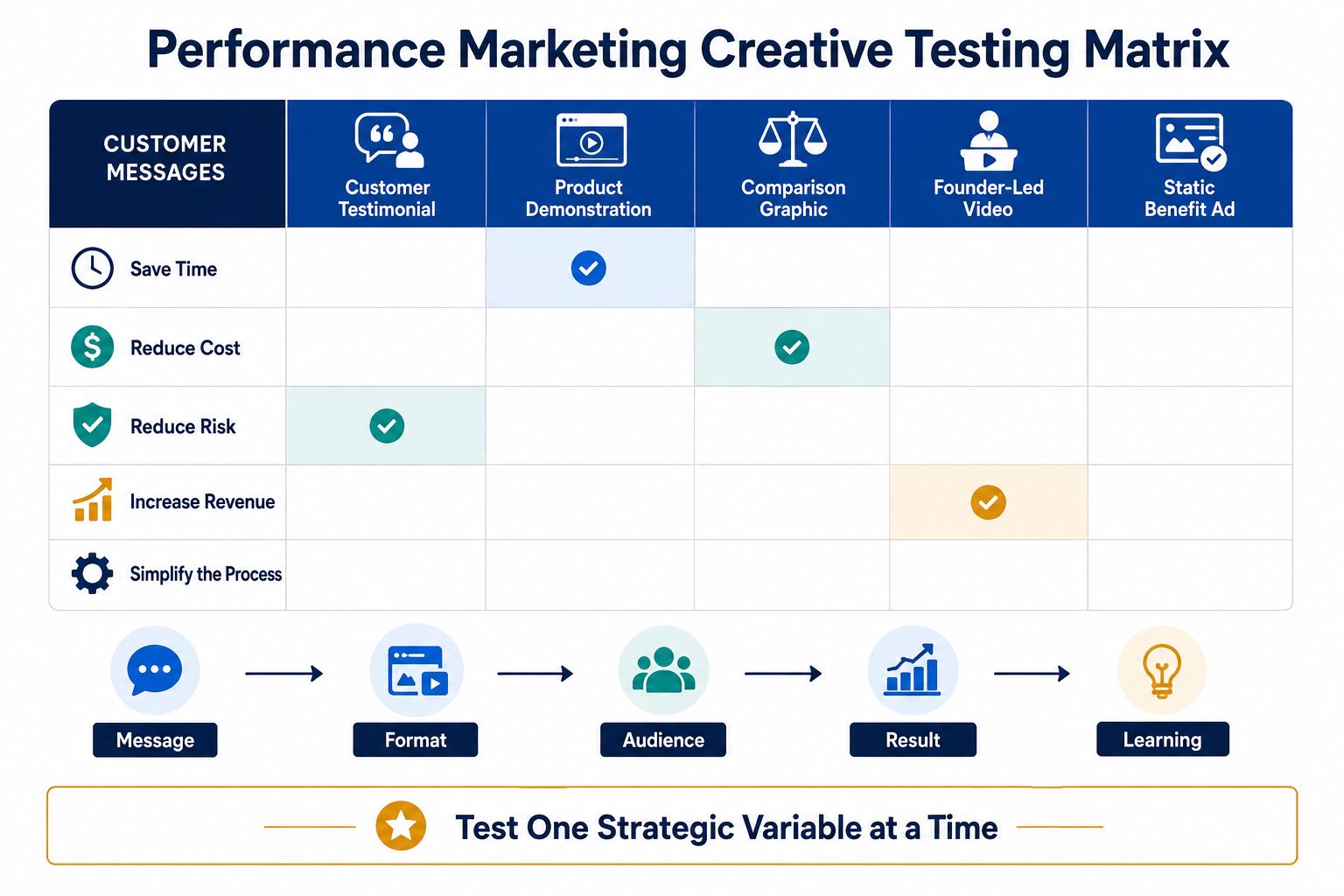
A testing matrix creates structured variation across several dimensions:
- Customer problem
- Desired outcome
- Value proposition
- Objection
- Proof point
- Offer
- Format
- Call to action
For example, one ad may focus on saving time, another on reducing cost, and another on avoiding risk. Each message can then be tested with testimonials, demonstrations, comparison graphics, founder-led videos, or product-focused formats. This approach produces more useful learning than changing several unrelated creative elements at once.
Creative should match the behavior and expectations of each platform. A search ad must respond directly to intent. A short-form video must earn attention quickly. A LinkedIn ad may require stronger professional relevance. A retargeting ad should address objections or provide proof rather than repeat the original message. Platform adaptation should not weaken brand consistency. The core positioning can remain stable while the format, pacing, hook, and level of detail change.
The experience after the click should continue the promise made in the ad. When an ad promotes a specific benefit or offer but directs users to a generic page, the customer must work harder to understand the connection. This creates friction and reduces conversion rates. Use consistent language, visual cues, proof, and calls to action across the entire conversion path.
Step 7: Build the Measurement and Attribution Plan
Measurement should be designed before campaigns launch, not added after performance questions appear. You have to Define Conversion Events and Tracking Requirements or a List of the events required to evaluate the funnel; Each event should have a clear definition, source of truth, owner, and validation process. Based on your brand type, These may include:
- Product views
- Form starts and submissions
- Purchases
- Demo requests
- Trial sign-ups
- Activated accounts
- Qualified opportunities
- Closed customers
- Repeat purchases
Connect Advertising Platforms, Analytics, and CRM Data
Advertising platforms show how campaigns generate interactions and attributed conversions. Analytics tools show website and product behavior. CRM and revenue systems show lead quality, sales outcomes, and actual customer value. These systems should be connected where possible;
Why?! Imagine using google ads panel and google analytics and tag manager, for your data collection you have to create tags with TGM but if it’s not connected to GA4, Where do you want store them? or if you G-ads is not connected to GA4, google analytics might not be able to detect sessions from G-ads.
For lead-generation businesses, campaign and click identifiers should be passed into the CRM. For ecommerce companies, order values, refunds, margins, and repeat purchases should be included in performance analysis.
Understand the Limitations of Platform Attribution
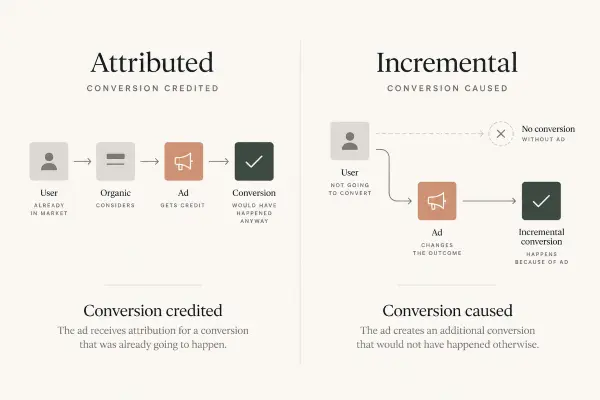
Advertising platforms typically assign conversion credit based on their own attribution windows, tracking methods, and identity models. As a result, the same conversion may be attributed to several channels at once. Platform reporting is valuable for optimizing campaigns within each channel, but it should not be treated as the definitive source of business performance. To build a more accurate view, compare platform-reported results with web analytics, CRM data, backend revenue, and blended acquisition metrics.
Businesses with multiple online touchpoints can consolidate channel-level data and build a more comprehensive attribution system. Marketing automation and customer data platforms can simplify this process by integrating data from different sources. Companies with sufficient engineering resources can also collect API gateway logs, store them in a dedicated analytical database such as ClickHouse, and use the resulting dataset to support attribution analysis or train machine-learning models for marketing teams. However, both approaches require significant investment, and custom machine-learning systems are often too expensive and complex for smaller organizations.
Move Beyond Last-Click Measurement
Last-click attribution gives all credit to the final measurable interaction. This can undervalue channels that create awareness, introduce the brand, or influence the decision earlier in the journey. Use a combination of methods where appropriate:
- Multi-touch attribution
- Blended CAC and ROAS
- Geographic or audience holdout tests
- Conversion-lift studies
- Marketing mix analysis
- Pre- and post-campaign comparisons
No attribution method is perfect. The goal is to make better investment decisions by combining several forms of evidence.
Step 8: Create an Experimentation Framework
Experimentation turns performance marketing into a repeatable learning process.
Turn Insights into Testable Hypotheses
A useful hypothesis explains the expected change and the reason behind it. For example:
“Replacing product-focused copy with risk-reduction messaging will increase qualified conversion rate because customer interviews show that implementation concerns are the primary objection.” This is more useful than simply stating, “Test new copy.”
Note: Testing priorities should be based on expected impact, confidence, effort, and strategic importance. Minor button or color changes may be appropriate later, but they rarely solve fundamental performance problems. High-impact tests often involve:
- Audience selection
- Value proposition
- Offer structure
- Creative concept
- Landing-page experience
- Conversion flow
- Pricing or packaging
Step 9: Launch, Optimize, and Scale the Strategy
The launch should be treated as the beginning of the learning process rather than the final stage of planning. Avoid launching too many audiences, creatives, campaigns, and offers simultaneously. Excessive fragmentation slows learning and makes it difficult to determine what is driving performance. Confirm that tracking, budgets, landing pages, reporting, and CRM processes are functioning before increasing spend.
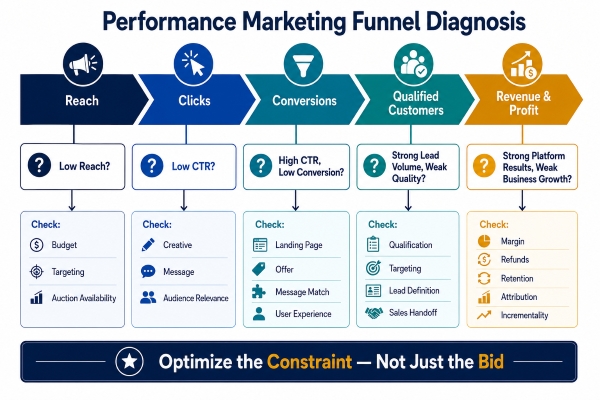
When performance is weak, identify where the funnel is breaking. Low reach may indicate restrictive targeting or insufficient budget. Low click-through rate may suggest weak creative or messaging. Strong click-through rate with poor conversion may indicate audience mismatch, landing-page friction, or an uncompetitive offer. Good lead volume with weak revenue may point to lead-quality problems, poor qualification, or sales-process issues. Optimization should address the constraint rather than automatically changing bids or budgets.
Decide What to Stop, Improve, or Scale
Every review should lead to one of three decisions:
- Stop: The opportunity lacks sufficient evidence or economic potential.
- Improve: The underlying signal is promising, but execution needs adjustment.
- Scale: Performance is validated and the business can support additional volume.
Stopping weak campaigns is an essential part of budget allocation. Maintaining every campaign because it has produced some conversions reduces overall efficiency.
Common Performance Marketing Strategy Mistakes
Common mistakes include treating campaign tactics as a substitute for strategy, setting targets without considering business economics, and optimizing platform metrics that do not reflect revenue or profit.
Teams also create risk when they spread limited budgets across too many channels, scale before validating the conversion funnel, or ignore lead quality, churn, refunds, and contribution margin.
Creative fatigue is another frequent problem. A previously successful campaign may decline because the audience has seen the same message too often.
Finally, platform attribution should never be accepted without verification. Strong reported ROAS does not always mean the channel created incremental business growth.
Frequently Asked Questions
How many channels should a performance marketing strategy include?
Start with the smallest number of channels required to reach the target audience and generate meaningful learning. For many businesses, one or two primary channels plus retargeting and a controlled experimental channel are enough initially.
How much budget is needed to test a new channel?
The budget should be large enough to generate a meaningful number of conversions based on the expected CPA. A test that cannot produce enough data to support a decision is usually underfunded.
What is the most important performance marketing KPI?
The most important KPI is the metric most closely connected to profitable business growth. Depending on the business, this may be contribution profit, CAC, qualified pipeline, activated customers, or lifetime value.
When should a performance marketing campaign be scaled?
Scale when tracking is reliable, conversion quality is acceptable, unit economics meet the target, and performance remains stable across enough volume and time to reduce uncertainty.
How often should the strategy be reviewed?
Campaign performance may be reviewed daily or weekly, but strategic assumptions are usually reviewed monthly or quarterly. Major changes should be driven by evidence rather than short-term platform fluctuations.
Final Thoughts
In this blog of amin farahani’s website you have learned: A successful performance marketing strategy is not a collection of advertising tactics. It is a decision-making system that connects business economics, customer understanding, channel execution, measurement, and experimentation.
The goal is not simply to generate more conversions. It is to learn where profitable growth comes from, invest in validated opportunities, and build an acquisition engine that can scale without losing customer quality or financial discipline.