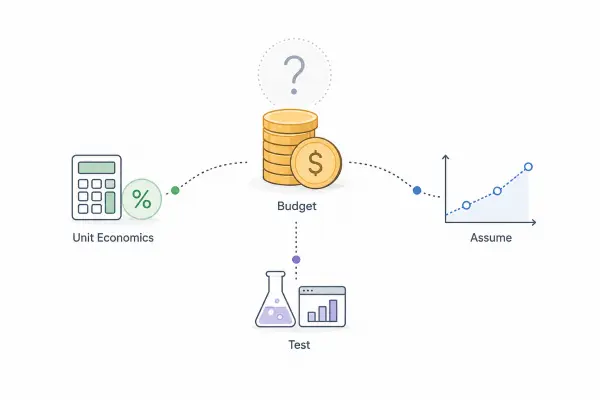
Performance marketing needs more than campaigns and dashboards. Every activity should support a business result, measurable target, and agreed method for evaluating success.
Learning how to set performance marketing goals connects business outcomes with realistic targets, SMART goals, KPIs, execution, and regular review.
What Are Performance Marketing Goals?
Performance marketing goals describe the results marketing should help achieve. They guide budget, channel selection, audience targeting, measurement, and optimization.
Effective goals go beyond ambitions such as “grow faster.” They focus on outcomes such as qualified leads, customer acquisition, sales, revenue, retention, or efficiency.
Performance Marketing Goals vs. Performance Marketing Objectives
A performance marketing goal describes the broader result, while an objective turns it into a specific outcome for campaign planning. For example, the goal may be customer acquisition, while the objective is generating more paid-search customers within a defined period and cost range.
The Difference Between Objectives and KPIs
An objective states what should change, while a KPI shows whether it is happening. For lead-generation efficiency, cost per lead may be the main KPI, supported by conversion rate and qualified-lead volume; read what is KPI in digital marketing for more detail.
Start With the Business Outcome
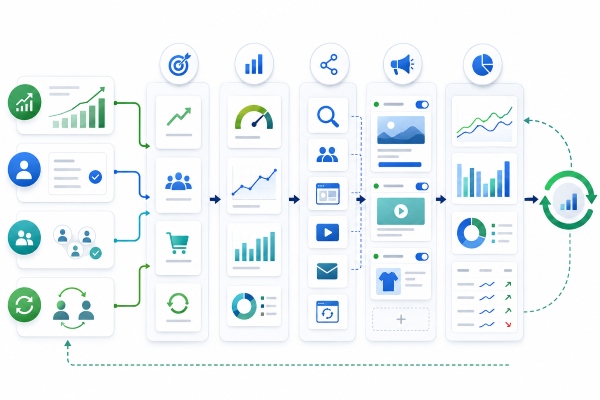
performance Marketing goal setting should begin with the result the business needs, not a platform feature or activity. First identify whether the priority is revenue, leads, acquisition, or retention.
This gives marketers a basis for campaign decisions and helps CMOs evaluate budgets. It also keeps reporting focused on business contribution rather than isolated platform numbers.
Connect Marketing Goals to Revenue, Leads, or Retention
Choose an outcome that matters to the business and can be influenced by marketing. Lead-generation teams may prioritize qualified leads, while ecommerce teams may focus on sales, revenue, conversion rate, or ROAS.
The outcome must shape campaign choices. Otherwise, teams may optimize clicks, impressions, or engagement without knowing whether they support growth.
Prioritize the Goals That Matter Most
Trying to improve every metric at once weakens focus. Give each campaign one primary objective and a few supporting indicators.
For a customer-acquisition campaign, completed purchases may be the main result. Cost per acquisition and conversion rate can show whether the campaign produces it efficiently.
Use Existing Data to Set Achievable Marketing Targets
Data-driven marketing goals should start with current results, campaign history, budget, team capacity, and time. These factors determine what improvement is realistic.
External benchmarks may add context, but they should not replace your baseline. The target should reflect your audience, offer, resources, and previous performance.
Establish Your Current Performance Baseline
A baseline is the starting point used to measure improvement. Review recent results for the primary KPI and supporting metrics.
If a campaign has a stable monthly lead volume, use that figure to define the improvement target. Confirm that the budget and sales team can support the increase.
Account for Budget, Time, and Team Resources
Achievable marketing targets must reflect the resources required. Larger targets may need more media budget, creative production, stronger landing pages, or sales support.
Time also matters. New campaigns may need testing, while established campaigns may provide enough history for a more confident target.
Turn Your Objective Into a SMART Marketing Goal
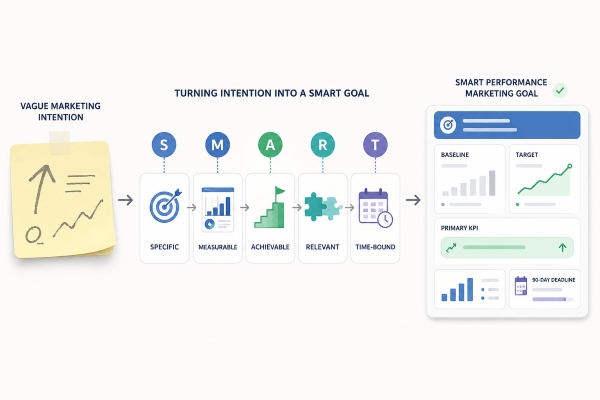
SMART marketing goals convert broad intentions into measurable commitments. The framework asks whether a goal is specific, measurable, achievable, relevant, and time-bound.
A complete SMART goal states the expected result, measurement method, and deadline. It creates a shared definition of success before launch.
Make the Goal Specific and Measurable
State exactly what should improve and how it will be measured. “Generate more leads” does not define the amount, source, quality, or period.
A stronger version is: “Increase monthly qualified paid-search leads from the current baseline to the approved target within 90 days.” It includes a baseline, target, channel, and timeframe.
Make the Target Achievable and Relevant
The target should be ambitious but supported by data and resources. Consider campaign history, budget, audience, creative capacity, and operational capacity.
It must also support a business priority. More traffic is not a useful primary goal when the business needs qualified leads or profitable sales.
Give the Goal a Clear Timeframe
A deadline creates accountability and defines when progress should be evaluated. Without one, teams cannot judge whether improvement is happening quickly enough.
Choose a period that fits the campaign and available data. A 90-day target may allow testing, supported by weekly or monthly reviews.
Match Marketing KPIs and Goals
Marketing KPIs and goals must be connected. The goal defines the desired result, while the KPI provides evidence of progress.
Do not choose metrics only because platforms display them prominently. Select one primary KPI and a few supporting indicators.
KPIs for Traffic and Engagement Goals
Traffic campaigns may track visits, clicks, click-through rate, cost per click, reach, or engagement. These metrics show whether the campaign attracts attention and sends users to the intended destination.
When the objective is leads or sales, traffic metrics remain supporting indicators. They should not replace the business outcome.
KPIs for Lead and Customer Acquisition Goals
Lead and acquisition goals may use qualified actions, conversion rate, cost per lead, cost per acquisition, or customer volume. The KPI should match how the business defines value.
A lower cost per lead is not better when quality declines. Review efficiency alongside the volume and quality of actions.
KPIs for Sales and Revenue Goals
Sales-focused campaigns may track purchases, revenue, conversion rate, ROI, or ROAS. These KPIs connect campaign activity with commercial performance.
Revenue indicates scale, while ROI or ROAS evaluates efficiency. Combining an outcome metric with an efficiency metric provides a fuller view.
Build a Performance Marketing Strategy Around the Goal
After defining the goal, objective, and KPI, build the campaign around them. Targeting, channels, budget, creative, landing pages, and testing should support the same result.
For the complete process, read The Complete Guide to Performance Marketing Strategy. That cluster page can cover execution while this article stays focused on goal setting.
Choose Channels Based on the Objective and Audience
Select channels because they fit the objective and audience, not because they are popular. Paid search, social advertising, display, and affiliate activity support different needs.
The channel should provide a realistic path to the desired action and allow measurement. Channel selection should follow the goal.
Assign Actions, Resources, and Responsibilities
A measurable target still needs an execution plan. Define the budget, campaign actions, creative assets, landing-page work, reporting process, and owners.
Clear ownership improves review meetings. The team can identify what was completed, where performance changed, and what should happen next.
Monitor and Adjust Digital Marketing Performance Goals
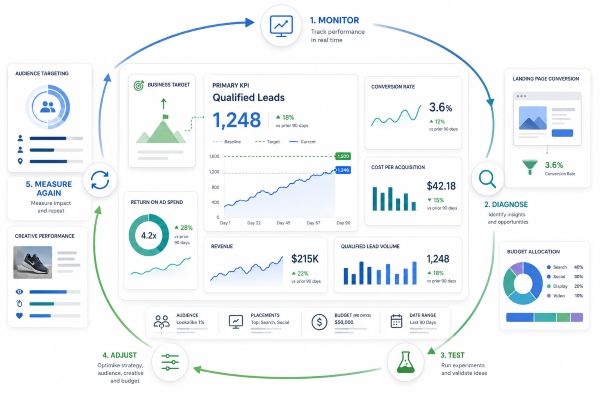
Digital marketing performance goals should be reviewed consistently after launch. Monitoring shows whether targeting, budget, messaging, creative, or landing pages need adjustment.
Keep the business objective as the reference point. Tactics may change, but optimization should support the agreed outcome.
Create a Consistent Review Schedule
Set review intervals before launch. Weekly reviews can guide operational decisions, while monthly or 90-day reviews assess broader progress.
A shared dashboard should show the baseline, target, current result, primary KPI, and supporting indicators. This gives teams a consistent view of success.
Adjust the Strategy Using Performance Data
When results fall behind target, use supporting metrics to investigate. Causes may include traffic quality, audience selection, conversion rate, cost, creative, or landing-page performance.
Do not replace the goal because one tactic underperforms. Adjust the strategy, test the change, and compare results with the same objective.
Common Performance Marketing Goal-Setting Mistakes
Goal setting becomes less useful when teams confuse activity with outcomes, copy targets without context, or track too many metrics. These mistakes weaken evaluation and accountability.
A structured process prevents them by defining the outcome, baseline, target, KPI, timeframe, and review method before committing budget.
Measuring Activities Instead of Outcomes
Launching campaigns, publishing content, and producing creative are actions, not final goals. They describe what the team will do, not the value it should create.
Connect each action to a measurable result. A campaign launch may support lead generation, but the goal should describe the expected outcome.
Copying Targets Without Using Your Own Data
Industry examples may provide context, but they may not reflect your audience, budget, offer, margins, or history. Copying them can create unrealistic expectations.
Start with your own baseline and resources. Use external information as supporting context rather than the foundation of the target.
Tracking Too Many KPIs
A long metric list can look detailed while hiding the main result. Teams may spend more time explaining numbers than deciding what to improve.
Use one primary KPI and limited supporting indicators. This keeps the connection between campaign performance and the business goal clear.
Set Goals Before You Launch the Campaign
Strong performance marketing goals begin with a business outcome, realistic baseline, and SMART target. Relevant KPIs then show whether the campaign is progressing and where changes are required.
Set the goal before choosing tactics. Clear objectives, targets, KPIs, ownership, timeframes, and reviews make your performance marketing strategy easier to execute and improve.