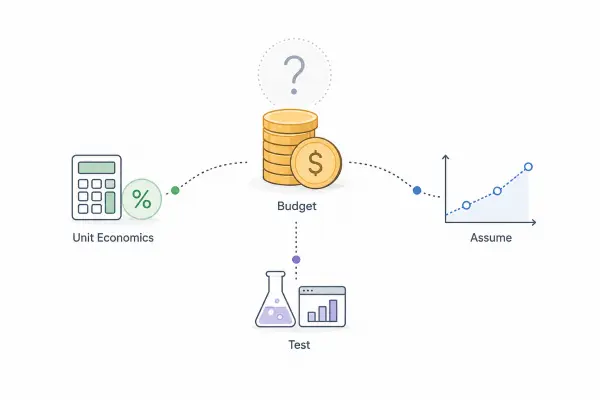
There is no monthly advertising budget that works for every small business. A useful budget must be large enough to produce meaningful data but affordable enough to maintain without damaging cash flow.
The right amount depends on revenue, margins, customer value, conversion rates, growth goals, and competition. This guide explains how to calculate a realistic small business digital advertising budget instead of relying on a generic industry average.
How Much Should a Small Business Spend on Digital Advertising?
For many small businesses, $500 to $3,000 per month can support a focused campaign on one platform. However, this is only a planning range, not a guarantee of results.
A local company testing a narrow market may learn something useful with $500 to $1,000 per month. A business in a competitive industry, targeting several locations, or seeking a consistent volume of leads may need considerably more.
The best approach is usually to fund one well-selected channel properly. Dividing a limited monthly advertising budget across Google, Meta, LinkedIn, and several other platforms can leave every campaign underfunded.
| Budget stage | Monthly media spend | Best use |
|---|---|---|
| Limited validation | $500–$1,000 | Test one audience, offer, or local market |
| Focused single channel | $1,000–$3,000 | Run and optimize a consistent campaign |
| Multi-campaign growth | $3,000–$5,000 | Test several campaigns or funnel stages |
| Competitive scaling | $5,000+ | Expand proven audiences, locations, or offers |
Digital Ad Spend Is Not the Same as Your Total Marketing Budget
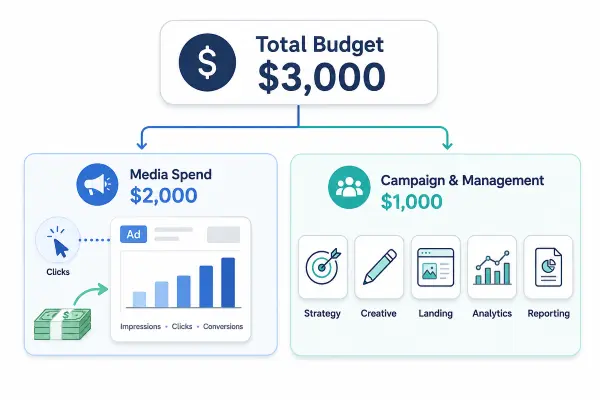
Your small business paid advertising budget normally has two parts.
Media Spend
Media spend is paid directly to platforms such as Google, Meta, Microsoft, LinkedIn, TikTok, or YouTube. This money is used to buy clicks, impressions, video views, leads, or conversions.
Campaign and Management Costs
These costs can include agency or freelancer fees, copywriting, graphic design, video production, landing pages, analytics tools, call tracking, and reporting.
For example, a total campaign budget of $3,000 might contain $2,000 in media spend and $1,000 in management and production costs.
Keeping these figures separate prevents you from overestimating the amount available for advertising. It also makes profitability easier to assess.
Three Ways to Calculate Your Digital Advertising Budget
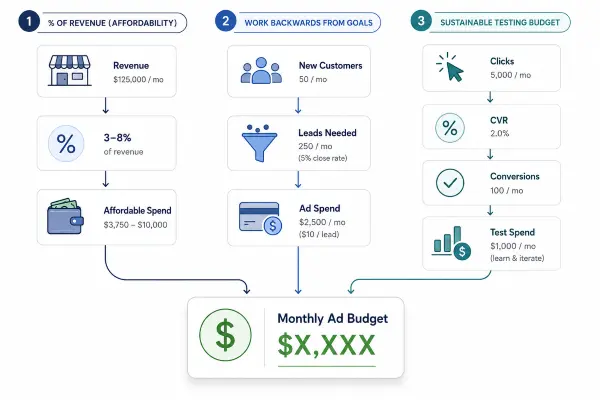
The strongest plan combines affordability, customer acquisition targets, and the amount of data required for a useful test.
Method 1: Use Revenue as an Initial Affordability Check
A percentage of revenue can establish an initial spending boundary, but it should not become a fixed rule. Companies with equal revenue may have very different margins, cash positions, and growth targets.
Suppose a business generates $600,000 in annual revenue and allocates 8% of that revenue to marketing:
- Annual marketing budget: $48,000
- Monthly marketing budget: $4,000
- Portion assigned to paid advertising: 50%
- Monthly digital advertising budget: $2,000
This calculation shows what may be affordable. It does not prove that spending $2,000 will acquire customers profitably.
You still need to compare the budget with your customer acquisition economics.
Method 2: Work Backward From Your Customer Target
A more practical approach is to start with the number of customers you want to acquire.
Required leads = Target new customers ÷ Lead-to-customer conversion rate
Required ad budget = Required leads × Target cost per lead
Imagine that a service business wants 10 new customers per month. It converts 20% of its qualified leads into customers and can afford to pay $60 per lead.
- Required leads: 10 ÷ 20% = 50
- Required ad budget: 50 × $60 = $3,000 per month
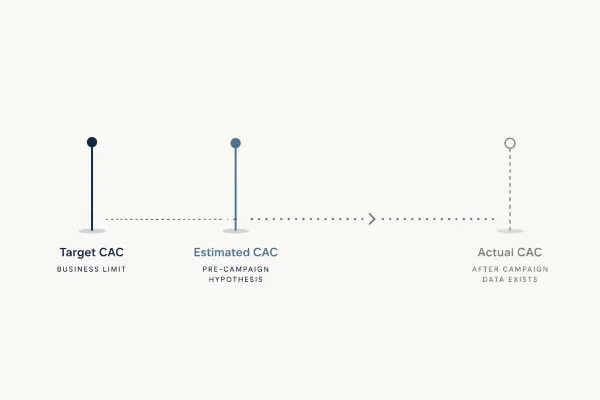
This method is useful because it connects spending to a business result. However, the target cost per lead must still reflect your profit margin, customer lifetime value, and sales capacity.
Method 3: Set a Sustainable Testing Budget
A test budget should produce enough conversions to support a decision. Clicks and impressions alone rarely show whether a campaign can acquire profitable customers.
Consider your expected cost per click, landing-page conversion rate, required number of conversions, and test duration.
For example, suppose clicks cost $5 and the landing page converts 5% of visitors. The estimated cost per lead would be $100:
$5 cost per click ÷ 5% conversion rate = $100 cost per lead
If you need 20 leads to make a reasonable initial assessment, the test may require approximately $2,000 in media spend. A $200 budget would probably take too long to provide useful evidence.
Testing does not remove uncertainty, but it prevents your small business online advertising budget from being based entirely on assumptions.
What Factors Should Change Your Advertising Budget?
Customer Value and Profit Margin
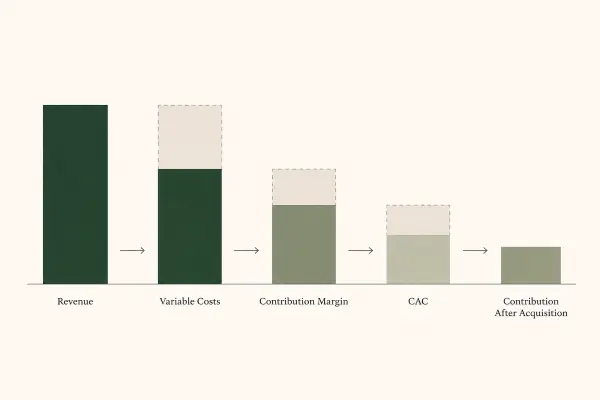
High margins, repeat purchases, subscriptions, or strong customer lifetime value can support a higher customer acquisition cost.
A low-margin business must be more cautious, even when revenue appears healthy. Revenue alone does not show how much you can afford to spend to acquire a customer.
Industry and Geographic Competition
Advertising costs change according to industry, location, platform, audience size, and search intent.
A narrow local campaign may cost far less than competitive legal, software, financial, or home-service campaigns targeting several cities.
Website and Sales Conversion Rates
Advertising cannot permanently compensate for a weak landing page, unclear offer, or slow sales process.
Improving conversion rates may produce more growth than increasing digital ad spend. Before raising your budget, check whether visitors understand your offer and can easily complete the desired action.
Growth Speed and Operational Capacity
Your budget should reflect how many customers the business can realistically serve.
More advertising makes little sense when calls go unanswered, inventory is limited, or fulfilment capacity is already stretched. Growth becomes expensive when the business cannot handle the demand it creates.
Sample Monthly Digital Advertising Budgets
The following scenarios represent media spend only. Management, creative production, software, and landing-page costs should be budgeted separately.
$500–$1,000: A Controlled Local Test
This range may suit a business with a narrow service area, one clear offer, existing creative assets, and one advertising platform.
Keep the targeting focused and select one important conversion goal. Trying to promote several services or target multiple audience groups may spread this budget too thinly.
$1,500–$3,000: A Focused Acquisition Program
This budget provides more room for campaign learning, keyword or audience testing, remarketing, and ongoing optimization.
It can support a meaningful single-channel program in many markets, although highly competitive industries may still require more.
$3,000–$5,000+: A Growth and Scaling Budget
At this level, a business may be able to run several campaigns, test more creative variations, target multiple locations, or cover more than one stage of the customer journey.
Additional channels should only be introduced after the initial campaign has produced stable and measurable results.
How Should a Small Business Split Its Advertising Budget?
Budget allocation should follow customer intent and channel purpose, not a universal percentage.
Demand-Capture Channels
Google Search, Microsoft Ads, shopping campaigns, and relevant local platforms reach people who are already searching for a solution.
These channels are often useful when demand already exists and the business wants to generate leads or sales now.
Demand-Generation Channels
Meta, LinkedIn, TikTok, YouTube, and display advertising can introduce an offer before customers actively search for it.
These channels often require stronger creative, more testing, and a longer measurement window.
When the budget is limited, concentrate it on the channel with the clearest audience and offer fit. My guide on how to create a paid media channel mix explains how to give each channel a specific role instead of dividing the budget evenly.
When Should You Not Increase Your Ad Spend?
Do not increase the budget simply because traffic is rising. First confirm that:
- Conversion tracking is accurate.
- The website produces qualified leads or sales.
- Leads receive a fast response.
- The sales team closes enough opportunities.
- Your margins support the current acquisition cost.
- The business can serve more customers.
- Results are repeatable rather than a temporary spike.
More spending magnifies existing weaknesses as easily as it magnifies growth. Fix measurement, conversion, sales, and operational problems before trying to scale around them.
Read More: How to set performance marketing goals?
How to Know When You Are Ready to Scale
You are generally ready to scale when tracking is reliable, the cost per qualified customer is acceptable, operational capacity is available, and campaign performance has remained reasonably stable.
There must also be a profitable destination for the additional budget. This might include new keywords, audiences, creative concepts, products, or geographic locations.
Increase spending gradually and monitor customer quality, conversion rate, customer acquisition cost, and profitability after each change.
For a broader framework, read my Complete Guide to Performance Marketing.
Frequently Asked Questions
Is $500 per Month Enough for Digital Advertising?
It can support a narrow local test, but it may be too low for competitive markets. Compare the budget with your expected cost per click, conversion rate, and required lead volume.
What Percentage of Revenue Should Go to Digital Ads?
Use revenue to establish an affordability boundary. Use profit margin and customer acquisition economics to determine the final amount.
Should Management Fees Be Included in the Advertising Budget?
Track them separately. Media spend shows platform performance, while total campaign cost shows the full financial investment required to generate results.
How Long Should a Small Business Test an Advertising Campaign?
Test until you have enough conversions to assess performance. A meaningful volume of data is more useful than an arbitrary number of days.
Should a Small Business Begin With Google Ads or Social Ads?
Choose Google Ads when customers are already searching for the solution. Choose social advertising when the offer depends more on visual discovery, audience targeting, education, or demand generation.
Conclusion
The best monthly advertising budget is not the largest amount a small business can afford. It is the amount the company can invest consistently while learning, acquiring suitable customers, and protecting profitability.
Start with one focused channel, reliable tracking, realistic acquisition targets, and a defined test. Scale only when the numbers and your operational capacity support the next stage of growth.
More practical digital marketing guidance is available on Amin Farahani’s website.