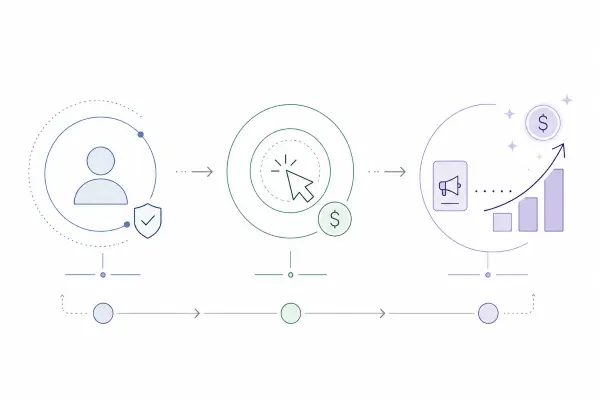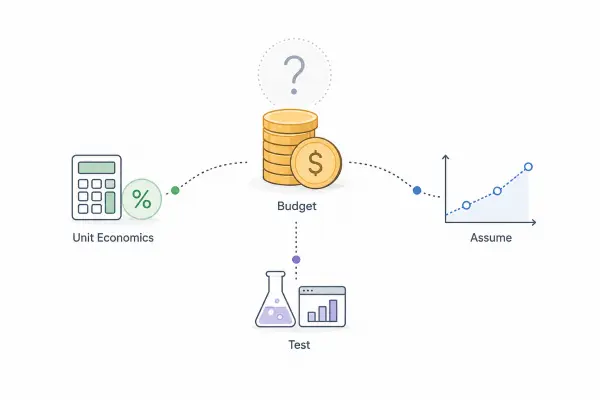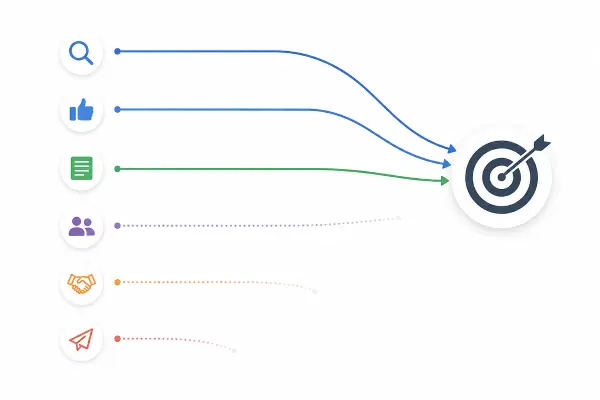
Businesses often choose acquisition channels because competitors use them, a platform is popular, or the team knows it well. That can create activity without sustainable growth because the right channel depends on customer behavior, economics, capabilities, and goals.
A better process is: business goal → customer behavior → channel fit → economics → test → scale. This guide explains how to choose the right acquisition channels, test them responsibly, and decide when to scale, improve, or stop.
What Is a Customer Acquisition Channel?
A customer acquisition channel is a repeatable route through which prospects discover a business, evaluate its offer, and become customers. Examples include search, paid social, outbound sales, referrals, affiliates, partnerships, events, and marketplaces.
Channels should support a wider growth system. Connect channel selection to your Complete Guide to Performance Marketing Strategy, where goals, audiences, budgets, and measurement work together.
Acquisition Channel vs. Marketing Tactic
A channel is the route used to acquire customers, while a tactic is a specific action inside it. Organic search is a channel; publishing comparison articles is a tactic. Paid social is a channel; testing testimonial videos is a tactic. Partnerships are a channel; running a co-marketing webinar is a tactic.
One weak tactic does not prove that the whole channel is unsuitable. However, repeatedly changing tactics will not repair a channel with poor customer fit or unsustainable economics.
Why There Is No Universal “Best” Acquisition Channel
A channel that works for a low-cost ecommerce product may fail for enterprise software with a long sales cycle. The best option depends on purchase intent, price, required trust, margins, lifetime value, budget, and capabilities.
Paid, owned, earned, and partner channels can all work. The useful question is: “Which channel can acquire valuable customers sustainably for this business?”
How to Choose the Right Acquisition Channels in Seven Steps
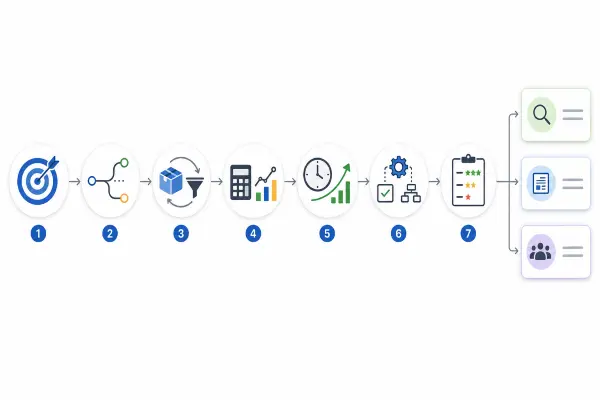
1. Start With the Business and Acquisition Goal
Define what the business needs: immediate sales, qualified pipeline, market entry, predictable volume, lower CAC, or long-term organic growth. “Get more traffic” is not enough because traffic matters only when it supports a commercial outcome.
Use [How to Set Realistic Performance Marketing Goals] to clarify the target, timeframe, constraints, and expected result before selecting channels.
2. Map How Customers Discover and Buy
Identify where customers search for information, whom they trust, how they compare alternatives, and where purchase intent becomes visible. Ask: Where is the customer already trying to solve this problem?
Do not confuse platform use with buying behavior. A decision-maker may use Instagram daily but rely on Google, industry communities, referrals, and vendor calls when evaluating business software. Channel-market fit exists when the channel matches both customer presence and buying context.
3. Match the Channel to the Product and Sales Cycle
Simple, low-priced products often suit direct-response channels, while expensive or complex offers require education, proof, and repeated contact. Search captures demand, content supports consideration, outbound reaches narrow audiences, referrals reduce trust barriers, and paid social can create demand.
The channel should match product complexity, purchase frequency, contract value, and whether the buying journey is self-serve or sales-assisted.
4. Evaluate the Channel Economics
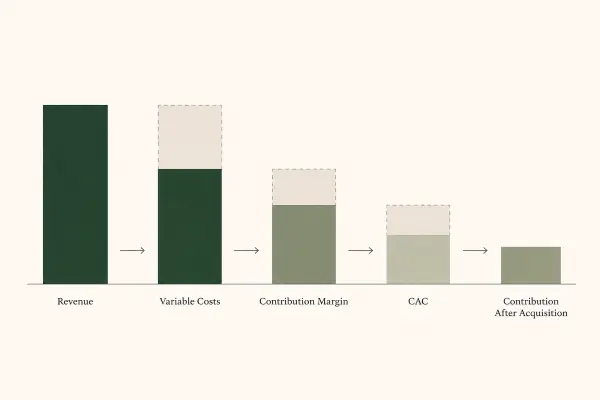
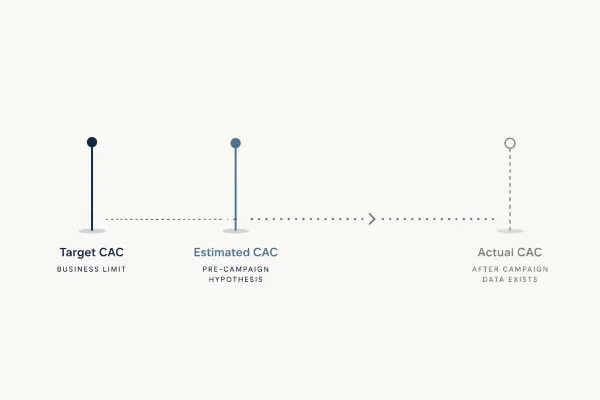
Compare customer acquisition cost, lifetime value, contribution margin, CAC payback period, conversion rate, average order or contract value, and retention. To calculate CAC for each marketing channel, divide channel-specific acquisition costs by the new customers attributed to that channel during the same period.
The cheapest lead source is not necessarily the best channel. A higher-CAC source may produce customers who retain longer and generate stronger margins. Use [How to Translate Business Goals into Marketing KPIs] to give every channel a KPI baseline, target, owner, and review cadence.
5. Consider Time to Impact and Scalability
Paid search may generate fast feedback but face demand and cost ceilings. SEO usually takes longer but can compound, while partnerships may be slow to establish and then deliver highly qualified customers.
A scalable channel continues producing incremental conversions as investment rises without pushing marginal CAC beyond acceptable limits. Early efficiency at a small budget does not guarantee efficient scale.
6. Audit Your Ability to Operate the Channel
Assess whether the team can create the required content or creative, fund the learning period, support the technology, respond to leads, and measure results reliably. Channel potential means little when the business cannot execute consistently.
Each channel also needs a clear owner responsible for execution, reporting, and learning.
7. Prioritize Channels With a Scorecard
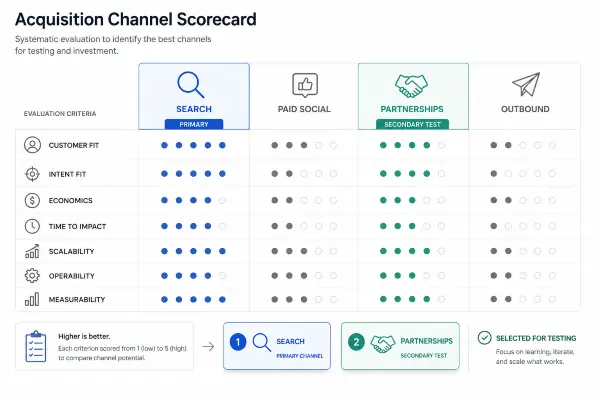
Score each candidate from one to five using the following acquisition channel selection framework. Use the questions below to compare options consistently:
| Criterion | Key question |
|---|---|
| Customer fit | Are target customers active here in a buying context? |
| Intent fit | Can the channel capture or create relevant demand? |
| Economics | Can CAC and payback become sustainable? |
| Time to impact | How quickly can it produce useful evidence? |
| Scalability | Can investment grow without excessive marginal CAC? |
| Operability | Can the team run it consistently? |
| Measurability | Can performance be evaluated credibly? |
The scorecard does not make the decision automatically. It exposes assumptions and helps determine which channel experiment deserves the first acquisition test budget.
How to Test an Acquisition Channel Before Scaling It
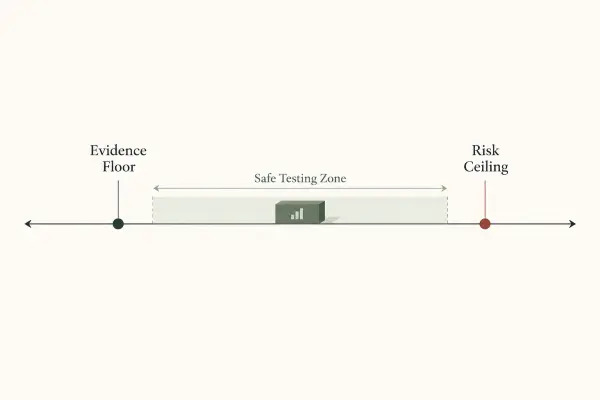
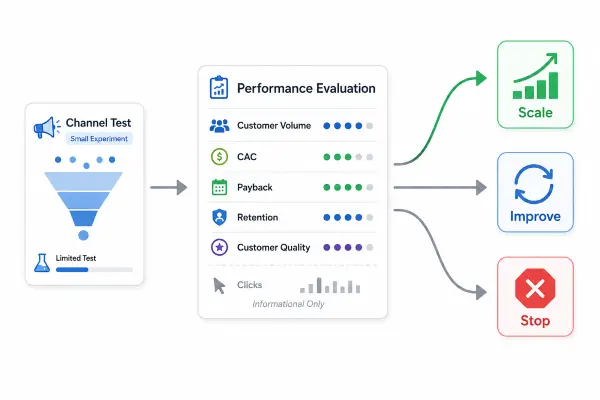
Channel selection is a hypothesis until customer behavior validates it. An acquisition channel testing framework should define the audience, offer, budget, marketing channel test duration, primary KPI, minimum acceptable result, and owner before launch.
The test must run long enough to reflect the buying cycle. Paid campaigns may provide evidence within weeks, while SEO, partnerships, and enterprise channels need longer. There is no universal answer to “How long should you test an acquisition channel?” because the test needs enough exposure and conversions to support a reliable decision.
Set Scale, Continue, and Stop Criteria
Define channel scaling criteria and channel kill criteria before viewing results. Scale when volume, customer quality, and economics meet the target. Continue when early signals are promising but evidence is limited. Stop when the channel repeatedly misses the threshold despite competent execution.
Do not judge SEO after several weeks, but do not fund paid campaigns indefinitely without improving unit economics. Useful channel success metrics balance volume with CAC, payback, retention, and contribution margin.
Customer Acquisition Channel Examples by Business Model
| Business model | Channels commonly worth testing | Main selection factors |
|---|---|---|
| B2B SaaS and high-ticket services | Search, content, outbound, webinars, partnerships, referrals | Contract value, trust, buying committee, sales cycle |
| Ecommerce and consumer products | Paid social, paid search, SEO, creators, affiliates, marketplaces | Margin, repeat purchases, creative capacity |
| Local and service businesses | Local SEO, paid search, referrals, reviews, partnerships, events | Geography, response time, reputation, capacity |
These are starting points, not fixed recommendations. A startup should usually test one or two channels deeply instead of spreading its budget across several weak experiments.
How to Compare Acquisition Channel Performance
To measure acquisition channel performance, compare CAC, payback period, retention, lifetime value, conversion quality, incremental conversions, and maximum scalable volume. Customer quality by acquisition channel matters because high conversion volume can hide churn, refunds, or weak margins.
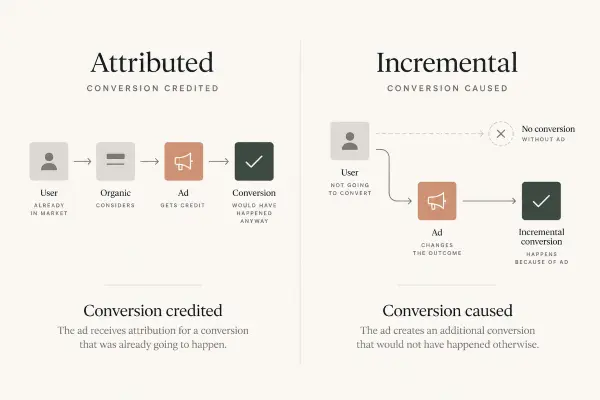
Marketing attribution by channel assigns credit, while acquisition channel incrementality asks whether the conversion would have happened without that activity. Last-click reporting can overvalue demand capture and undervalue earlier awareness or trust.
When to Scale, Diversify, or Stop a Channel
Scale when unit economics remain healthy and added investment produces incremental customers. Diversify when the primary channel approaches saturation, concentration creates risk, or a second channel passes a credible test.
Stop when a channel repeatedly misses minimum thresholds, attracts low-quality customers, or requires capabilities the business cannot sustain. Paid and organic channels are not direct substitutes; paid channels can provide speed and learning, while organic assets may create compounding growth.
Common Acquisition Channel Selection Mistakes
Copying Competitors Without Understanding Their Economics
Competitors may have different margins, brand strength, teams, data, and customer value. Their successful channel may be unsuitable for your business.
Testing Too Many Channels at Once
Limited budgets spread across too many channels rarely produce useful evidence. Most startups should validate one primary channel and perhaps one secondary test before increasing complexity.
Comparing Channels Only by Last-Click Conversions
Last-click models favor channels close to conversion and can ignore earlier demand creation. Compare attribution with assisted conversions, customer research, and incrementality tests where possible.
Scaling Before Measuring Customer Quality
Early conversion numbers can look strong even when customers churn, refund, or generate weak margins. Confirm retention and contribution quality before scaling.
Final Checklist for Choosing an Acquisition Channel
Before investing, confirm that customers use the channel in a buying context, the economics can become sustainable, the team can operate it, and the test has enough budget and time. Define customer-quality measures plus scale, continue, and stop thresholds before launch.
The right acquisition channel is not simply the one with the greatest reach or lowest initial CAC. It repeatedly acquires valuable customers at sustainable economics and can be operated well by the business. For practical support, explore my performance marketing service or learn more about Amin Farahani.