Advertising performance can look impressive while still failing to generate profit. A campaign may produce strong revenue, but low margins or high fulfillment costs can still make that Return on ad spend unsustainable. Every business should therefore calculate break-even ROAS before setting campaign targets. It shows the minimum advertising revenue needed to recover product costs and ad spend without making a profit or loss. In this guide, you’ll learn how to calculate break-even ROAS using gross margin, evaluate campaign profitability and set a safer target above break-even.
What Is Break-Even ROAS?
Many advertisers choose ROAS targets from industry benchmarks or platform recommendations. These figures do not reflect an individual business. A company with a 70% gross margin can remain profitable at a much lower ROAS than a company with a 20% margin. Gross margin therefore supports realistic advertising targets.
Break-even ROAS is the return on ad spend at which advertising revenue covers the cost of the products sold and the advertising expense. At this point, the campaign is not generating profit, but it is not losing money on the transaction. Knowing this threshold helps marketers judge whether a campaign is sustainable. It prevents teams from celebrating a strong-looking number that creates no real profit.
Note : If you are NOT familier with ROAS, I reccomond read What is ROAS in digital marketing blog first.
Understanding ROAS Before Calculating the Break-Even Point
ROAS measures how much revenue is generated for every dollar spent on advertising. The basic formula is:
ROAS = Revenue From Ads ÷ Advertising Spend
If a business spends $5,000 on ads and generates $20,000 in tracked revenue, its ROAS is 4x. This means it generated $4 in revenue for every $1 spent on advertising. ROAS helps compare campaigns, channels, and audiences. However, it measures revenue efficiency rather than profitability because it excludes costs, fees, returns, and overhead.
Why High ROAS Does Not Always Mean Profit
A high ROAS can still produce weak financial results when gross margins are low. The same 3x ROAS may be profitable for one company and unprofitable for another. Imagine two businesses that each generate $30,000 from $10,000 in ad spend. Business A has a 70% gross margin, leaving $21,000 before ad costs, while Business B has a 25% margin, leaving only $7,500. Business A earns money, while Business B loses $2,500 after advertising.
How Gross Margin Affects Break-Even ROAS
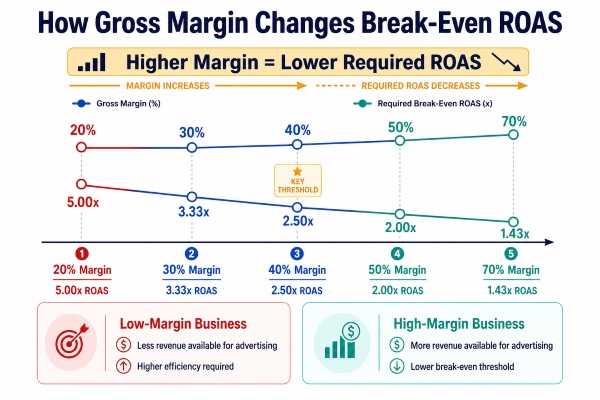
Gross margin determines how much of each revenue dollar remains after direct product costs are paid. That remaining amount must cover advertising and other operating expenses. As gross margin decreases, the required break-even ROAS increases. Low-margin businesses must generate more revenue from each advertising dollar because less money is available for acquisition.
What Is Gross Margin?
Gross margin is the percentage of revenue remaining after subtracting the direct cost of delivering the product or service. It is calculated with this formula:
Gross Margin = (Revenue − Cost of Goods Sold) ÷ Revenue
Suppose a product sells for $100 and costs $40 to produce, package, and fulfill. The gross profit is $60, and the gross margin is 60%. The costs included depend on the business model. Product cost, packaging, fulfillment, payment processing, and shipping subsidies may belong in the calculation when they directly affect each sale.
The Relationship Between Gross Margin and Advertising Costs
Gross margin represents the maximum portion of revenue available to cover advertising before overhead and profit. If a product has a 40% gross margin, only $40 from every $100 in revenue remains after direct costs.
The business therefore cannot spend more than $40 to acquire that $100 in revenue without losing money at the gross-profit level. The lower the available margin, the more efficient advertising must be.
How to Calculate Break-Even ROAS Based on Gross Margin
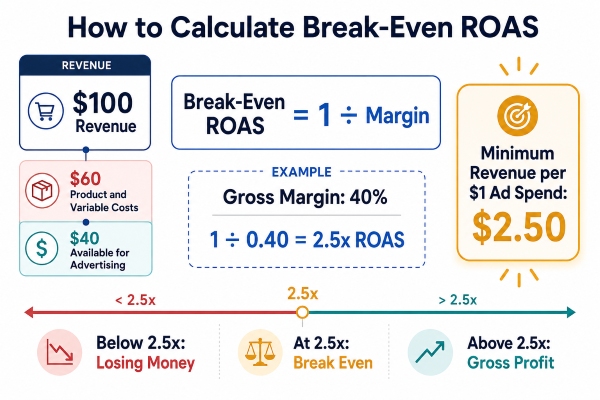
The calculation is simple once the correct gross margin is known. The main challenge is ensuring the margin reflects the real direct costs associated with each sale. Convert the gross margin percentage into a decimal and divide 1 by that number. The result is the minimum ROAS required to cover product costs and advertising spend.
Break-even ROAS formula
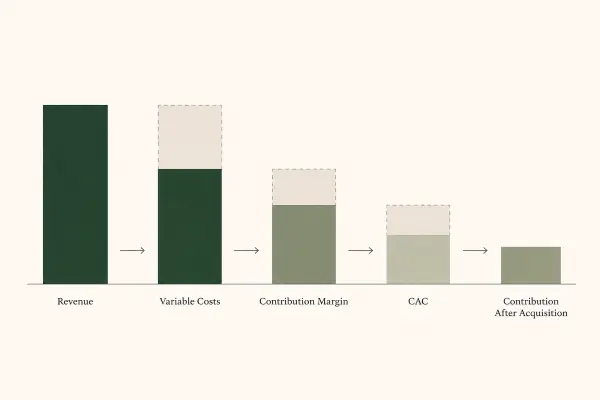
The simple formula often uses gross margin. However, advertisers may get a more realistic break-even ROAS by using an adjusted contribution margin that includes variable transaction costs such as payment fees, fulfillment, shipping subsidies and expected returns.
Break-Even ROAS(simple) = 1 ÷ Gross Margin
Break-Even ROAS(actual) = 1 ÷ Contribution Margin After Variable Costs
If gross margin is 50%, convert it to 0.50. The calculation becomes 1 ÷ 0.50 = 2, so the break-even ROAS is 2x.
Common examples include:
- 60% gross margin: 1.67x
- 50% gross margin: 2x
- 40% gross margin: 2.5x
- 30% gross margin: 3.33x
- 20% gross margin: 5x
These figures show why a universal “good ROAS” does not exist. A 2x ROAS may be healthy for a high-margin company but far below break-even for a low-margin retailer.
Break-Even ROAS Examples by Gross Margin
A comparison table makes the relationship between margin and required ROAS easier to see. As gross margin falls, break-even ROAS rises quickly. The figures below are a useful reference, but each company should use its own accurate cost data.
| Gross Margin | Break-Even ROAS |
|---|---|
| 20% | 5.00x |
| 25% | 4.00x |
| 30% | 3.33x |
| 40% | 2.50x |
| 50% | 2.00x |
| 60% | 1.67x |
| 70% | 1.43x |
A company with a 20% margin needs $5 in revenue for every $1 spent on ads just to break even. A company with a 70% margin reaches break-even at approximately $1.43 per advertising dollar.
Calculating Break-Even ROAS for a Business
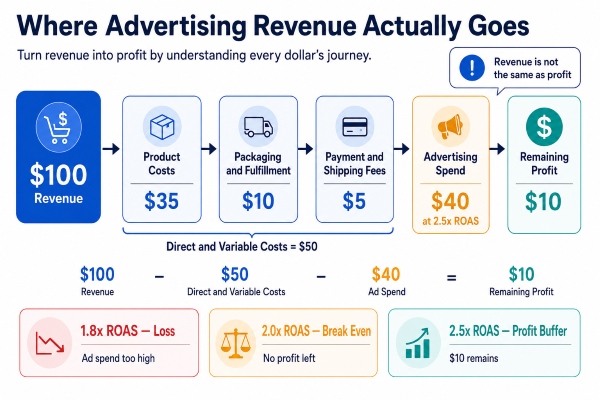
Consider an ecommerce company selling a product for $100. Product, packaging, and fulfillment costs total $50 per order, producing $50 of gross profit and a 50% gross margin.
The company can therefore spend up to $50 to generate a $100 sale before reaching break-even. The calculation is $100 ÷ $50 = 2x ROAS.
Example
The key figures are a $100 selling price, $50 in direct costs, $50 in gross profit, and a 50% gross margin. These inputs produce a break-even ROAS of 2x.
If the campaign produces a 1.8x ROAS, the business loses money at the gross-profit level. At 2x it breaks even, while anything above 2x begins generating gross profit after ad spend.
At a 2.5x ROAS, the company spends $40 to generate $100. After $50 in direct costs and $40 in advertising, $10 remains before overhead and taxes.
Common Mistakes When Calculating Break-Even ROAS
The formula is simple, but inaccurate inputs can make the result misleading. Businesses often use incomplete cost data or confuse revenue performance with profit performance.
A reliable calculation requires consistent accounting assumptions. The following mistakes are among the most common.
Using Revenue Instead of Profit Margin
Revenue alone does not show how much money is available to fund advertising. A company may generate substantial sales while keeping only a small percentage after direct costs.
Break-even ROAS must be based on margin rather than revenue volume. Otherwise, marketers may scale campaigns that increase sales while reducing profitability.
Ignoring Hidden Costs
Payment processing, shipping subsidies, returns, discounts, and fulfillment reduce the amount available for advertising. Excluding them makes gross margin appear higher than it is.
Businesses should decide which variable costs belong in the model and apply the same method consistently. A conservative estimate is usually safer than an optimistic one.
Copying Competitors’ ROAS Benchmarks
A competitor’s target may reflect different prices, margins, repeat purchases, or operating costs. Even similar companies may have different break-even points.
External benchmarks can provide context, but they should not replace internal financial data. The most useful target is the one tied to the company’s own unit economics.
How to Set a Profitable ROAS Target Above Break-Even
Break-even ROAS is a survival threshold, not an ideal performance target. A campaign operating at break-even leaves nothing to cover salaries, software, rent, taxes, or owner profit.
A profitable target should sit above the break-even level. The difference creates a buffer for the rest of the business.
Why Break-Even Should Not Be Your Final Goal
A company that consistently operates at break-even may grow revenue without improving financial health. It remains vulnerable to rising ad costs, refunds, conversion-rate changes, and tracking errors.
A higher target protects against normal fluctuations. It also creates room to reinvest in inventory, retention, and growth.
Adding a Profit Buffer to Your ROAS Target
Suppose a company has a 50% gross margin and a break-even ROAS of 2x. Management may choose a target of 2.5x or 3x to preserve operating profit.
At a 3x ROAS, the company spends about $33.33 to generate $100 in revenue. After subtracting $50 in direct costs and $33.33 in advertising, about $16.67 remains for overhead and profit.
The right buffer depends on operating expenses, growth goals, cash flow, and customer lifetime value. Businesses with repeat purchases may accept a lower first-order ROAS, but they should model the payback period carefully.
Final Thoughts: Use Gross Margin to Build Smarter ROAS Goals
Break-even ROAS turns advertising targets into financial decisions rather than arbitrary platform metrics. By connecting campaign performance to gross margin, marketers can identify the minimum return required to avoid losing money.
The formula is simple: divide 1 by gross margin expressed as a decimal. Then set a target above break-even that accounts for overhead, desired profit, risk, and the broader economics of customer acquisition. A good performance marketing service provider can calculate these numbers for you and make profitable advertising for your business, you can fill out a form on amin farahani’s website.