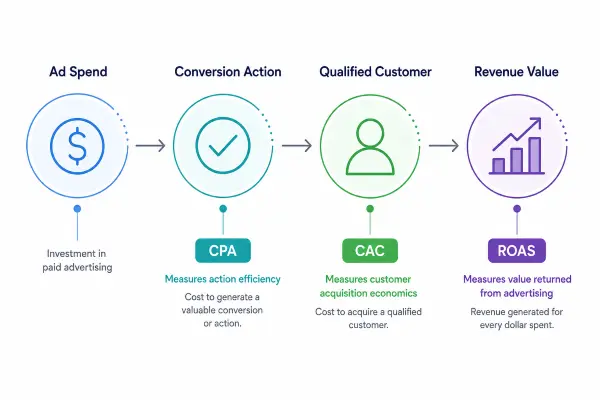
If CPA looks healthy, ROAS is strong, and CAC is climbing, should you keep spending? This is where many marketing dashboards become confusing. CAC, CPA, and ROAS are often treated as competing metrics, but they measure different parts of the acquisition system. A useful way to think about them is simple: CAC is the strategic acquisition guardrail, CPA measures the efficiency of a specific action, and ROAS measures the revenue or conversion value generated by advertising. So the goal is not to choose one winner. The goal is to decide which metric is allowed to control which decision.
CAC vs CPA vs ROAS: What Each Metric Actually Measures
CPA: The Cost of the Action You Optimize For
CPA tells you how much you spend to generate a specific conversion.The formula is straightforward:
CPA = Ad Spend ÷ Conversions
If you spend $5,000 and generate 100 qualified leads, your CPA is $50.The important part is the word conversion. A conversion does not necessarily mean a new customer. It might be a lead, booked demo, trial, signup, app installation, or purchase. That is why CPA is mainly an action-efficiency metric.It answers:
How efficiently am I generating the action this campaign is designed to produce?
This distinction is especially important when comparing customer acquisition cost vs cost per acquisition. They can occasionally be similar, but they are not automatically the same metric.
CAC: The Cost of Acquiring a Real Customer
CAC moves one step further down the funnel.
CAC = Acquisition Costs ÷ New Customers
Imagine those 100 leads produced 20 customers. If your total acquisition costs were $6,000, your CAC would be:
$6,000 ÷ 20 = $300
This is why CAC vs CPA matters so much.Your advertising dashboard might show a $50 CPA and look healthy, while the business is actually paying $300 to acquire each customer. CAC is therefore more useful when answering questions such as:
- How much can we afford to spend acquiring customers?
- Is growth economically sustainable?
- Can we increase the overall acquisition budget?
CAC belongs closer to the business decision than the campaign decision.
ROAS: Revenue or Conversion Value per Ad Dollar
ROAS measures how much attributed revenue or conversion value you generate relative to advertising spend.
ROAS = Attributed Revenue ÷ Ad Spend
If you spend $10,000 and generate $30,000 in attributed revenue:
ROAS = 3x
ROAS becomes particularly useful when conversions have different values. A campaign producing ten $1,000 orders is economically different from one producing ten $100 orders, even though both may show the same purchase CPA. That is the core difference in CPA vs ROAS: CPA focuses on the cost of producing conversions, while ROAS considers the value of those conversions. But a 3x ROAS does not automatically mean the campaign is profitable. Product margin, discounts, fulfilment costs, returns, and customer mix still matter.
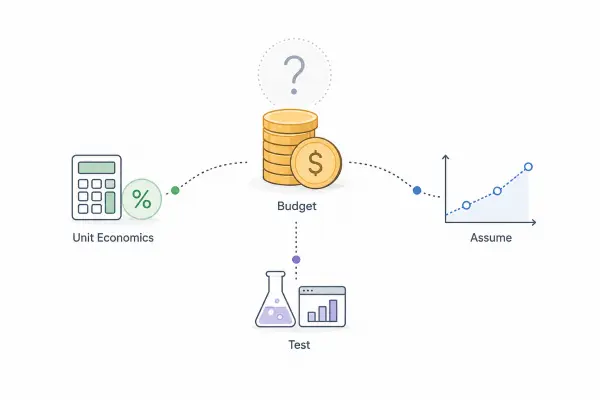
Which Metric Should Actually Control Your Marketing Budget?
This is where the metrics need different jobs. At the business level, CAC should usually act as the acquisition guardrail. Inside campaigns, CPA or ROAS can then help you decide how to generate that growth efficiently.
Use CAC as the Strategic Acquisition Guardrail
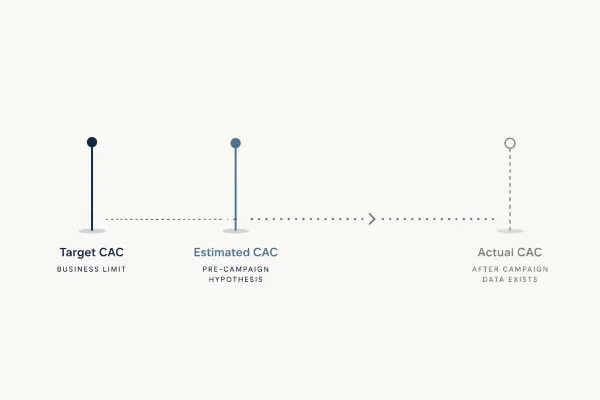
Suppose your business can sustainably afford an allowable CAC of $250.If acquisition rises to $350, a campaign can still show attractive platform metrics while creating poor business economics. This is why CAC should influence decisions such as:
- whether the company can afford faster growth;
- how large the acquisition budget can become;
- whether an additional customer is still economically valuable.
CAC becomes even more useful when considered alongside contribution margin, customer lifetime value, and the CAC payback period. For example, a SaaS company may tolerate a higher CAC if customers remain for years and the acquisition cost is recovered quickly. A low-margin ecommerce business may need much tighter limits. If you are building these decisions into a broader acquisition system, they should sit inside your performance marketing strategy rather than being treated as isolated advertising KPIs.
Use CPA When Conversions Have Similar Value
CPA works well when the action itself is reasonably consistent. For a lead-generation business, for example, campaigns might be managed around the cost of a qualified lead. If qualified leads have similar expected value, CPA provides a simple operational target. The mistake is assuming that a low CPA automatically means good acquisition. If one campaign generates leads at $40 but only 5% become customers, while another generates $70 leads with a 20% close rate, the more expensive campaign may produce the better CAC.
Use ROAS When Conversion Values Differ
ROAS becomes more useful when revenue is visible and conversion values vary.This is common in ecommerce. If one campaign sells mostly $50 products and another sells $400 products, comparing purchase CPA alone hides important information. ROAS gives you a better view of the value created by the spend. The same logic applies when deciding when to use CPA vs ROAS:
- Use CPA when you primarily care about the cost of a comparable conversion.
- Use ROAS when you care about the value generated by conversions.
- Use CAC when deciding whether acquiring the customer is economically sustainable.
Why Good CPA, CAC or ROAS Can Still Lead to Bad Budget Decisions
A metric can look good and still recommend the wrong action when it is viewed without context.

Low CPA but Poor Conversion Quality
Imagine two lead-generation campaigns. Campaign A produces leads at $30. Campaign B produces them at $60. At first glance, Campaign A seems obvious to scale. But if 5% of Campaign A leads become customers and 25% of Campaign B leads convert, Campaign B may be far more valuable. CPA measures the action. It does not guarantee the quality of what happens afterward.
High ROAS but Weak Customer Acquisition
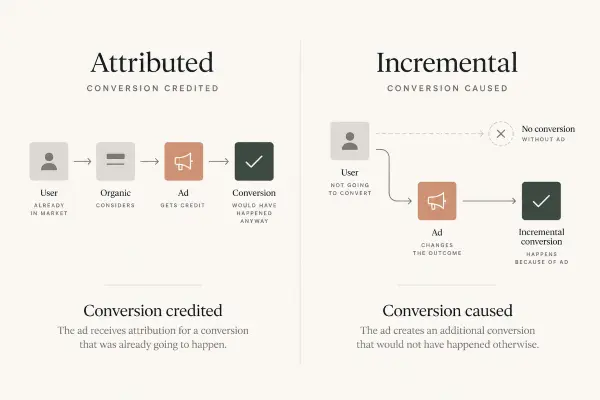
A high ROAS can also hide weak growth. For example, an ecommerce campaign may generate excellent returns because it captures branded searches or repeatedly sells to existing customers. That can be profitable, but it does not necessarily mean you are acquiring enough new customers. This is why mature ecommerce teams may also monitor new customer ROAS, not only blended ROAS. When thinking about ROAS vs CAC for budget allocation, ask whether the revenue being reported actually represents the type of growth you want to fund.
Low CAC but Poor Customer Economics
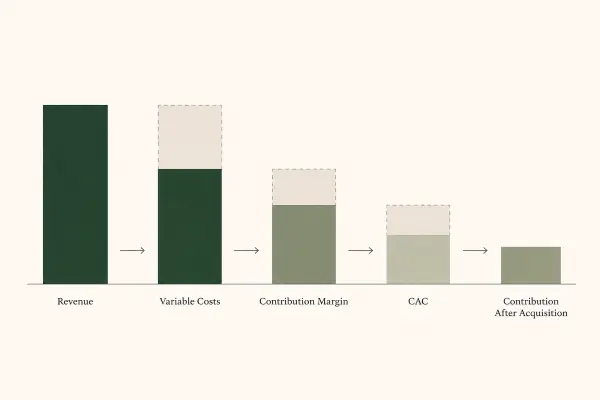
Even cheap customers can be bad customers. Suppose you acquire customers for $100, but the average customer’s contribution profit over the relevant period is only $80. The CAC looks low in isolation. The economics are still negative. This is why the LTV to CAC ratio, contribution margin, and payback period should act as context around CAC rather than being ignored.
Turn the Metrics Into Budget Guardrails
Metrics become much more useful when you turn them into limits that campaigns can operate inside.
Set an Allowable CAC
Start with how much the business can afford to pay for an additional customer. Suppose your allowable CAC is $250 and you want to acquire 20 customers.Your theoretical acquisition budget is:
20 × $250 = $5,000
That does not mean you should automatically spend $5,000. It means acquisition remains within your planned economics if you can actually acquire those 20 customers near that CAC.
Convert Your CAC Ceiling Into a CPA Target
For lead-generation businesses, you can work backward from CAC. Suppose: Allowable CAC = $300 and: 20% of qualified leads become customers Then: Target lead CPA = $300 × 20% = $60
Now your advertising target is connected to business economics instead of being chosen because “$60 feels reasonable.” This is one of the most practical ways to connect CAC and CPA.
Set a Minimum ROAS Floor
ROAS should be handled in a similar way. Instead of deciding that 3x or 4x is universally good, calculate the break-even ROAS your economics require. A business with strong contribution margins can often tolerate a lower ROAS than a business with thin margins. Your scaling logic might then look like this:
CPA below target + ROAS above your required floor + CAC below the allowable ceiling = potential to scale.
The word potential matters. As budgets increase, performance can change. A campaign that works at $5,000 per month may not maintain the same economics at $50,000. If establishing these thresholds, connecting advertising data to actual customer economics, and deciding where to increase spend is becoming difficult, this is also the type of problem I help businesses solve through my performance marketing service.
A Simple Rule for Deciding What to Scale
When the dashboard becomes noisy, return to the decision you are trying to make. If you are asking “How much does this action cost?”, use CPA.
- If you are asking “How much revenue or conversion value does this advertising generate?”, use ROAS.
- If you are asking “Can we afford to keep acquiring customers at this cost?”, use CAC.
Then apply one final rule: campaign metrics can recommend more spend, but business economics should have veto power. A strong target CPA or ROAS is useful only when the customers produced by that spend are economically worth acquiring. CAC, CPA, and ROAS work best when each metric has a clear job. Use CPA to manage actions, ROAS to manage value, and CAC to protect the economics of growth. That gives you a much better basis for deciding what to scale than trying to make one metric control the entire marketing budget.