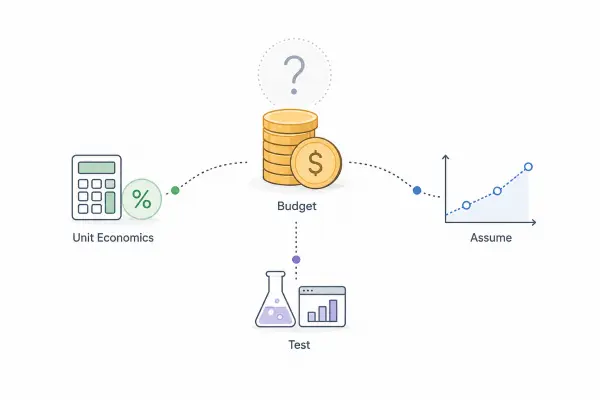
Setting a marketing budget is fairly straightforward when you already have a year of campaign data. You know roughly what a click costs, how many leads turn into customers, and which channels deserve more investment. But what if you have none of that? How to Set a Marketing Budget Without Historical Data ? The good news is that you don’t need historical data to create your first marketing budget. You need financial boundaries, reasonable assumptions, a measurable objective, and a test that helps you replace those assumptions with real data. In other words, your first marketing budget doesn’t need to predict the future perfectly. It needs to help you learn without putting too much money at risk.
Why Historical Data Isn’t Required to Set Your First Budget
Historical data makes budgeting easier because it reduces uncertainty. It doesn’t remove the need to make a decision. When you’re setting a marketing budget without historical data, the difference is that you have to be clear about what you know and what you’re assuming. For example, you may know your product price and gross margin but have no idea whether your customer acquisition cost will be $50 or $150. That’s fine. Your job isn’t to pretend you know the answer. Your job is to create a test that can find it. This is why an initial marketing budget should have two jobs:
- acquire customers
- generate information for your next decision.
Start With What You Know About the Business
If you’re trying to figure out how much to spend on marketing without data, don’t start with advertising platforms. Start with the business.
Define Your Business Goal
“Generate more sales” isn’t specific enough to build a budget around. Suppose your business wants to generate an additional $100,000 in revenue. If an average customer generates $1,000 in revenue, your marketing needs to help acquire roughly 100 additional customers. Now you have something you can work backward from. The same principle works for a lead-generation business. Instead of revenue → customers, you might calculate:
Revenue target → customers needed → qualified leads needed → marketing opportunities needed
This gives your budget a business purpose instead of simply choosing an amount that feels reasonable.
Calculate What You Can Afford to Acquire a Customer For
Next, estimate your maximum acceptable CAC. A simple starting point is:
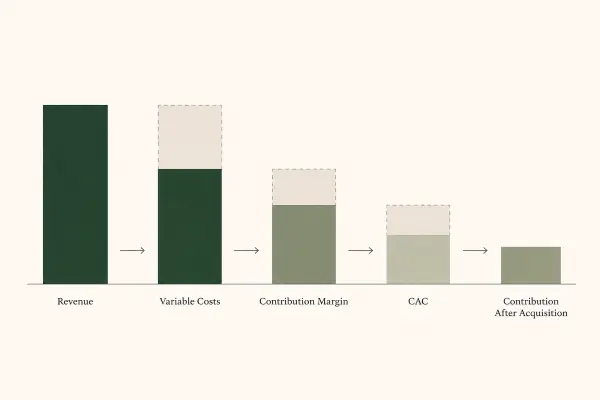
Maximum CAC = the amount of customer value or profit you can afford to invest in acquisition
Don’t blindly copy an “average CAC” from your industry. Your acceptable CAC depends on your own margins, customer lifetime value(LTV), cash flow, and required payback period. Two companies selling similar products may have completely different acquisition limits. This financial boundary is one of the most important inputs when you create a marketing budget from scratch.
Use External Data to Build Your First Assumptions
Once you know your financial limits, you can start filling in what you don’t know.
Use Industry and Channel Benchmarks
You may not have past campaign performance, but there is usually external information you can use to create your first marketing budget assumptions. Depending on the channel, you might research:
- CPC or CPM
- click-through rate
- landing-page conversion rate
- lead-to-customer conversion rate
- typical customer acquisition costs
The important word here is assumption. A benchmark is not a prediction. If another company has a 4% conversion rate, it doesn’t mean you’ll get 4%. Their brand(Brand awarness have more impact than you imagine) , offer, pricing, traffic quality, landing page, and audience may be completely different. Use marketing budget benchmarks for new businesses to establish a sensible range, not to manufacture certainty.
Use Comparable Products and Markets
If direct benchmarks aren’t available, look for useful proxies.Maybe you have launched the same product in another geography. Maybe your sales team already knows how prospects react to the offer. Perhaps there are comparable products serving a similar customer. None of these are perfect substitutes for your own campaign data, but they’re better than guessing randomly. Marketing budget forecasting without historical data is mostly about building reasonable assumptions and then testing them quickly.
Build Three Budget Scenarios Instead of One Forecast
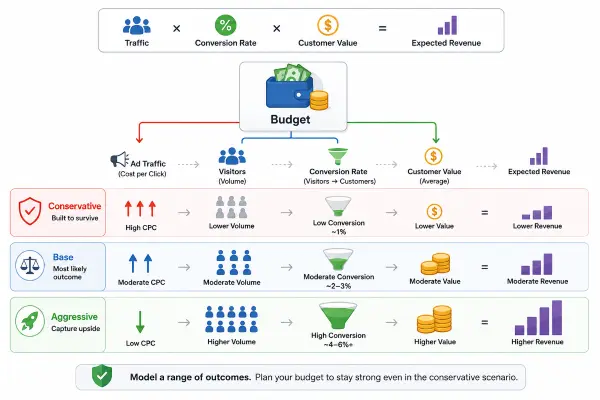
One of the easiest mistakes when creating a marketing budget with no data is building one spreadsheet and treating the result as truth. Instead, create three scenarios.
Conservative, Base and Aggressive Scenarios
Start with a simple model such as:
Traffic × conversion rate × customer value = expected revenue
Now change the assumptions. In your conservative scenario, traffic may cost more and conversion rates may be lower than expected.Your base scenario represents what you currently believe is reasonable.Your aggressive scenario shows what happens if the campaign performs better than expected. Imagine you expect 1,000 visits and a 3% conversion rate. That’s 30 conversions. But what happens if the real conversion rate is only 1.5%?
- If that outcome creates a serious cash-flow problem, your starting budget is probably too aggressive.
- Good marketing budget scenario planning doesn’t ask only, “How much could we make?”
It also asks, “What happens if we’re wrong?”
Your first budget should be able to survive the conservative scenario.
Turn Your Initial Marketing Budget Into a Controlled Test
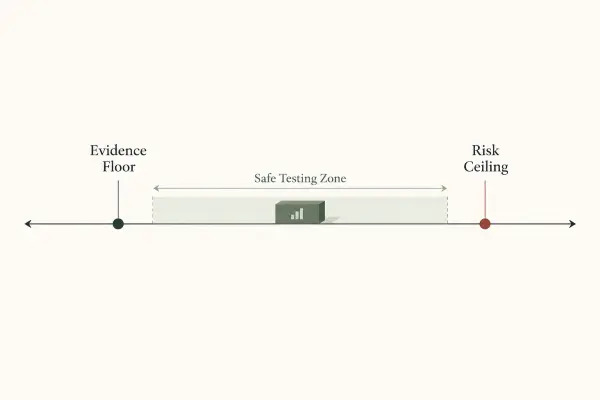
Once you have an affordable range, resist the temptation to spread the money everywhere. Suppose you have €5,000 available. Dividing €500 across ten different marketing channels may look diversified, but you can easily end up with ten experiments that don’t generate enough information to tell you anything useful.Instead, prioritize channels based on four things:
Audience + buying intent + economics + measurable conversion
Choose one or a small number of channels where you can run a meaningful experiment. If you’re building a broader acquisition system, my Complete Guide to Performance Marketing Strategy explains how channels, measurement, economics, and scaling decisions fit together.
Define the Minimum Budget Needed to Learn
Instead of asking: “What percentage of revenue should we spend on marketing?” Ask: “How much do we need to spend to learn whether this acquisition model can work?” That’s your marketing test budget.
You’re trying to generate enough conversions, qualified leads, or meaningful buying signals to evaluate your assumptions. This mindset is especially useful when creating a marketing budget for a new business or a marketing budget for a new product launch, where past performance may simply not exist. If you’re unsure how to structure the initial test, measurement, and optimization process, this is also something I help businesses solve through my performance marketing service. The goal isn’t simply to spend more on ads; it’s to find an acquisition model that can justify more investment.
Set Kill, Continue and Scale Rules Before You Spend
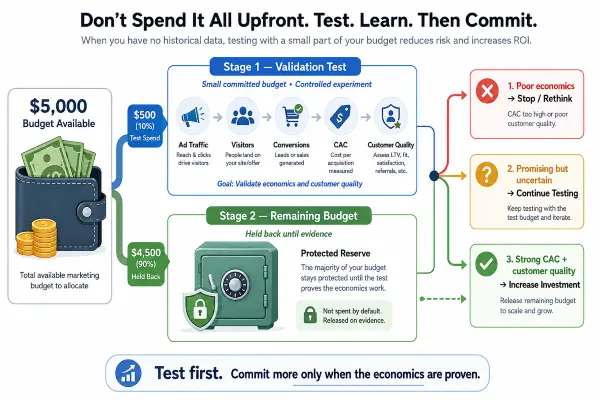
Decide what you’ll do with the results before seeing them. Otherwise, it’s surprisingly easy to keep spending because a campaign “looks promising.”
Stop or rethink the experiment when results clearly violate your business economics. For example, if customer acquisition costs remain far above your acceptable CAC and there is no clear reason to believe optimization can close the gap, more budget may simply create a larger loss.
Sometimes results aren’t bad; they’re just inconclusive.You may have promising conversion rates but too few customers. Or acquisition cost looks reasonable while customer quality is still unclear. In that case, continuing the test can make sense.
Increase investment when CAC, customer quality, margins, and payback period support it. Even then, scale gradually. Performance at $1,000 of spend doesn’t guarantee identical economics at $10,000. This is especially important in marketing budget allocation with limited data: every increase in budget should earn its way through evidence.
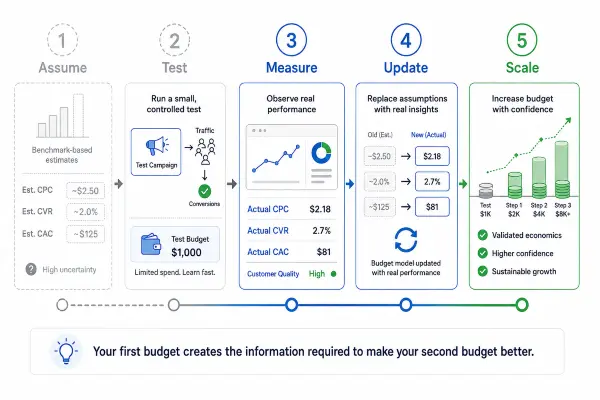
Replace Assumptions With Real Data
Your first campaign changes the budgeting process. Before the test, you had:
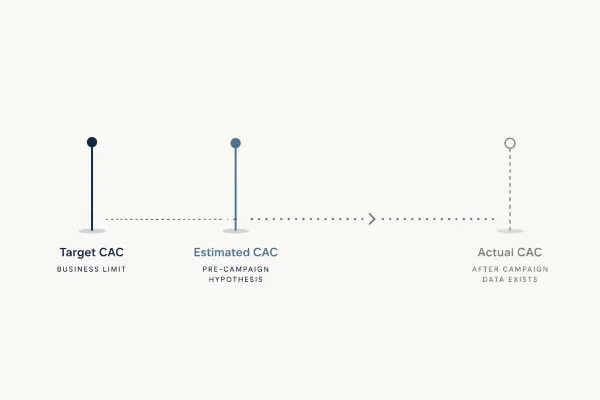
Benchmark CPC → Estimated conversion rate → Assumed CAC → Expected customer quality
After the test, you begin to have:
Observed CPC → Actual conversion rate → Actual CAC → Observed customer quality
Now your second budget can be better than your first. The process becomes:
Assume → Test → Measure → Update → Scale
As more data becomes available, reduce your reliance on external benchmarks and increase your reliance on your own economics. That’s how a marketing budget without past performance data gradually becomes a data-driven budget.
A Simple Marketing Budget Example Without Historical Data
Imagine a business wants to acquire 20 new customers. After looking at its margins, customer value, and payback requirements, it determines that the maximum acceptable CAC is $250. The theoretical acquisition budget is: 20 customers × $250 CAC = $5,000
But spending the full $5,000 immediately would assume the $250 CAC is achievable. Instead, the company could allocate a smaller portion to an initial validation test. Suppose the first test shows a CAC of $180 with good-quality customers. That’s a signal to continue and gradually increase investment. If CAC reaches $500 with weak customer quality, the company can stop before committing the remaining budget And if results are somewhere in between, it can optimize the offer, targeting, creative, or funnel and test again. That’s the practical answer to how to set a marketing budget from scratch: don’t bet the entire budget on assumptions. Use part of the budget to test whether those assumptions deserve more money.
Final Takeaway
You don’t need perfect historical data to set a responsible marketing budget.You need to understand what the business can afford, create reasonable assumptions, model the downside, and spend enough to generate useful evidence. Your first marketing budget isn’t supposed to prove that you predicted everything correctly. It should protect your downside while buying enough information to make the next decision better. That’s also the principle behind the data-driven approach I use across Amin Farahani: make assumptions when you have to, measure what happens, and let evidence decide where the next dollar goes.