Performance marketing and growth marketing are often described in similar terms. Both teams claim to be data-driven, experiment-led, and accountable for business growth. Yet in practice, they frequently operate with different objectives, metrics, responsibilities, and time horizons.
The central distinction is straightforward:
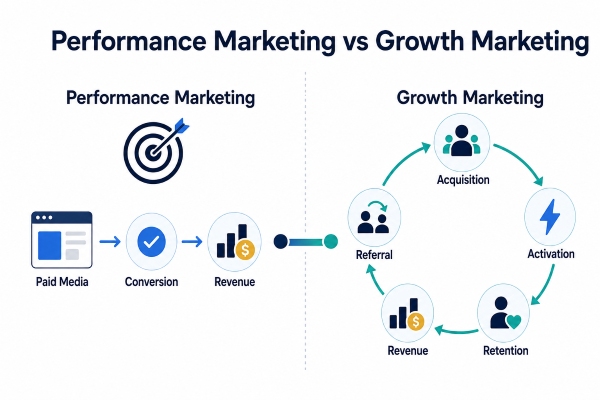
Performance marketing is designed to generate and optimize measurable acquisition outcomes. Growth marketing coordinates experiments across acquisition, activation, retention, revenue, and referral to create sustainable business growth.
For most established companies, the decision is not whether to choose performance marketing or growth marketing. The challenge is determining how the two should work together.
Performance Marketing vs Growth Marketing at a Glance
| Area | Performance Marketing | Growth Marketing |
|---|---|---|
| Primary objective | Generate measurable acquisition, pipeline, or revenue efficiently | Improve the overall system that creates sustainable growth |
| Scope | Primarily acquisition and conversion | Entire customer lifecycle |
| Time horizon | Campaign, monthly, or quarterly outcomes | Short-term experiments and long-term compounding improvements |
| Typical channels | Paid search, paid social, affiliates, programmatic, sponsorships | Paid media, product, onboarding, lifecycle, pricing, referrals |
| Core metrics | CAC, CPA, ROAS, conversion rate, pipeline | Activation, retention, LTV, churn, expansion, revenue growth |
| Experimentation focus | Creative, bids, audiences, landing pages, offers | Acquisition, product, onboarding, pricing, retention, referrals |
| Team ownership | Usually marketing-led | Cross-functional |
| Main business risk | Paying for attributed conversions that do not create incremental value | Running broad experiments without financial accountability |
Performance marketer asks:
“How efficiently can we generate this outcome?”
Growth marketer asks:
“Where is the next constraint or opportunity in the growth system?”
Why the Two Are Frequently Confused?
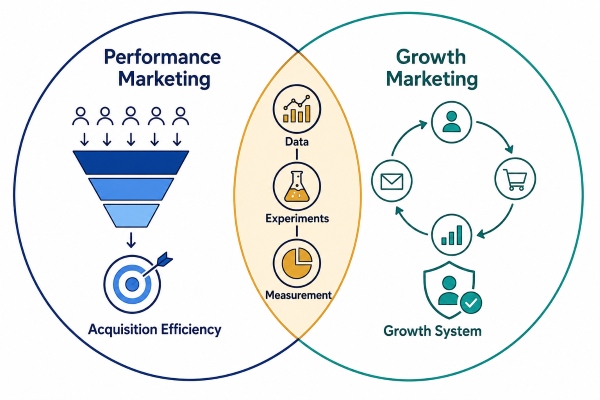
Performance marketing and growth marketing share many operating principles. Both use data, experimentation, measurement, and optimization. Growth teams frequently use paid media, while performance teams can contribute to retention, revenue, and customer-value objectives.
The difference is not whether the team uses analytics, testing, or paid channels. The difference is the scope of the problem it owns and their strategy (you can read my performance marketing strategy post if you want to learn about it).
What Performance Marketing Actually Optimizes?
PM is an acquisition and demand-capture discipline in which spending is tied to measurable actions. Those actions may include purchases, qualified leads, subscriptions, app installs, booked demonstrations, or pipeline creation. Its purpose is not simply to generate traffic. It is to convert marketing investment into measurable commercial outcomes at an acceptable cost (Read more: What is performance marketing?).
Objectives, Channels, and Operating Model
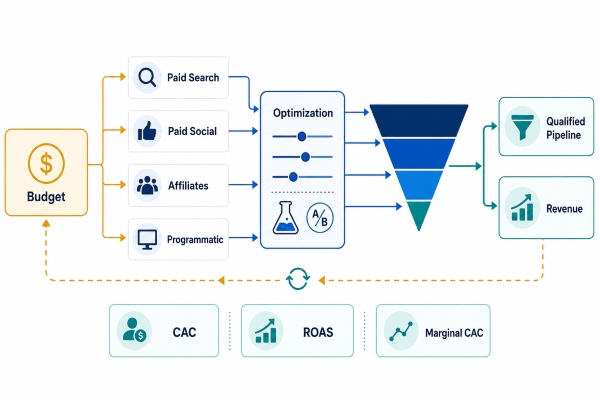
Performance teams commonly work across:
- Paid search(most of the time we use google ads due to their market share.)
- Paid social
- Affiliate and partner marketing
- Display and programmatic advertising
- Sponsored placements
The operating model depends on continuous budget reallocation. Spend moves toward the audiences, channels, campaigns, offers, and creative combinations producing the strongest returns. The team may test several variables simultaneously, but the central question remains financial: which investments should receive the next unit of budget?
The Metrics Performance Teams Manage
Performance teams typically manage:
- Customer acquisition cost(CAC)
- Cost per acquisition(CPA)
- Return on ad spend(ROAS)
- Conversion rate
- Qualified pipeline
- Payback period
- Marginal acquisition cost
- Incremental revenue
Metrics such as clicks, impressions, and click-through rate remain useful, but they are diagnostic indicators rather than final business outcomes. A high CTR is valuable only when it contributes to profitable customer acquisition or qualified pipeline.
What Growth Marketing Actually Optimizes?
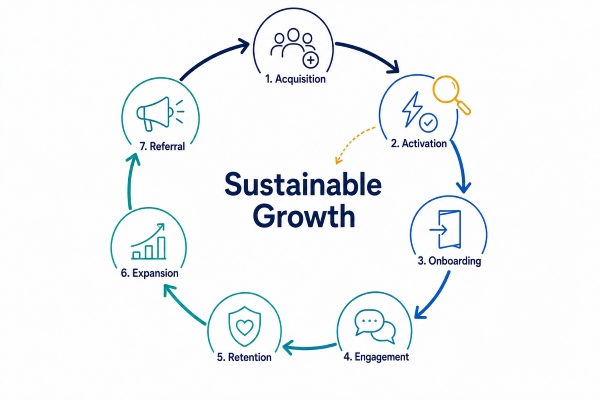
Growth marketing is a cross-functional system for identifying and removing constraints across the customer lifecycle. Rather than assuming that the next growth opportunity is another campaign, growth marketers examine the wider system. The highest-impact lever may be a channel, but it could also be the product, offer, onboarding process, pricing model, lifecycle communication, sales workflow, or referral mechanism.
Growth Marketing Goes Beyond Acquisition
Growth marketers may work across:
- Acquisition
- Activation
- Onboarding
- Engagement
- Retention
- Expansion
- Referral
For example, a company may appear to have an acquisition problem because revenue growth has slowed. Further analysis may reveal that acquisition volume is sufficient, but users are failing to activate, customers are churning early, or sales-qualified leads are not progressing through the pipeline. Growth marketing shifts attention toward the constraint with the greatest impact on business growth.
The Metrics Growth Teams Manage
Growth teams commonly track:
- Activation rate
- Retention and churn
- Customer lifetime value
- Expansion revenue
- Referral rate
- Time to value
- Revenue growth
- LTV-to-CAC ratio
They need both leading indicators and financial outcomes. Activation may predict future retention, for example, but it should eventually connect to revenue, margin, or customer value. By comparing the metrics it’s become more clear which team handels what, right?
The Key Differences Between Performance and Growth Marketing
Business Objective and Time Horizon
performance team usually works against a defined acquisition, pipeline, or revenue target within a campaign, month, or quarter. The focus is often on improving the efficiency and scale of an existing conversion path.
Growth marketing may pursue longer-term improvements that compound over time. These can include stronger onboarding, better retention, organic acquisition loops, improved product adoption, or customer referrals.
That does not mean growth marketing is always slow. A pricing experiment or onboarding improvement can generate immediate results. The distinction is that growth marketing considers how the improvement affects the broader system, not only a campaign result.
Funnel Scope and Customer Ownership
The performance team most often owns acquisition and conversion outcomes. Its responsibilities may end when a purchase, signup, qualified lead, or booked meeting is generated.
Growth marketing examines the complete customer lifecycle. It may share ownership with product, sales, customer success, data, engineering, and revenue operations.
This distinction is particularly important in B2B organizations. Generating more form submissions does not necessarily create growth. The company must also consider lead quality, sales acceptance, pipeline progression, deal velocity, win rate, contract value, retention, and expansion.
Channel Selection vs Constraint Identification
Performance marketers often begin with a channel, audience, offer, and conversion target. They may ask how paid search can produce more qualified leads or how paid social can acquire customers at a lower cost.
In other hand, growth marketers begin with a constraint or opportunity. If activation is weak, the solution may involve onboarding. If acquisition costs are rising, the answer may be stronger retention, referrals, pricing, or conversion. The appropriate lever could be a paid campaign, but it could also be a product change, referral program, packaging experiment, or lifecycle initiative.
Measurement and Attribution
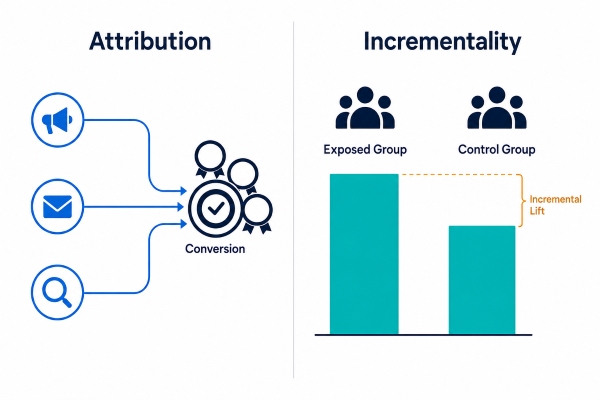
The performance team relies heavily on campaign-level measurement and attribution. Teams need to understand which ads, keywords, audiences, and channels are associated with conversions. Growth marketing evaluates whether an intervention improves the wider business system.
This requires distinguishing between:
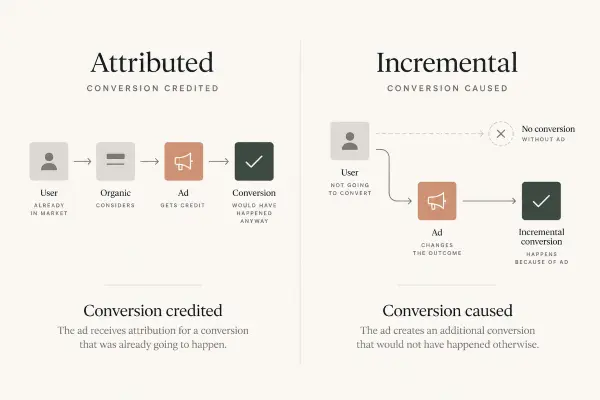
- Attributed conversions and incremental conversions
- Platform-reported revenue and actual business impact
- Short-term ROAS and long-term customer value
- Average CAC and marginal CAC
A platform may claim credit for revenue that would have occurred without the campaign. Similarly, a campaign may appear profitable based on initial revenue while attracting customers with weak retention or low margins. Attribution explains where credit is assigned. Incrementality estimates what happened because of the investment.
Experimentation Cadence
Performance experiments typically focus on:
- Bids
- Budgets
- Targeting
- Creative
- Offers
- Landing pages
- Conversion flows
Growth experiments may include all of these, but can also involve:
- Product experience
- Onboarding
- Lifecycle messaging
- Packaging
- Pricing
- Sales processes
- Customer referrals
Performance optimization is usually concentrated within marketing-controlled systems. Growth experimentation follows the constraint, even when the solution sits outside marketing.
Where Each Approach Can Fail
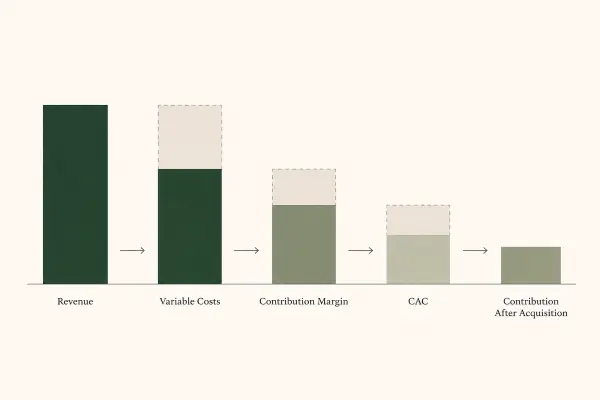
Each approach have it’s own weaknesses, for example : Performance marketing becomes dangerous when optimization is disconnected from the wider customer economics. A team may continue hitting platform-level targets while the underlying business becomes less efficient. More leads may create additional sales workload without increasing pipeline. More customers may generate revenue while reducing contribution margin.
Growth marketing can also fail when experimentation becomes too broad or loosely accountable.Performance discipline gives growth teams financial accountability. Growth thinking gives performance teams the broader context needed to avoid optimizing a single channel at the expense of the business.
Common risks for each approach may include :
- Performance marketing:
- Growing dependence on paid platforms
- Rising marginal CAC
- Optimizing for low-quality conversions
- Attribution inflation
- Weak retention
- Growth disappearing when spending stops
- Scaling campaigns before fixing the offer or customer experience
- Growth marketing:
- Experiments disconnected from revenue
- Excessive focus on engagement metrics
- Unclear ownership
- Slow prioritization
- Testing without enough traffic
- Weak statistical discipline
- Labeling every marketing activity a growth experiment
When Should a Company Prioritize Each Approach?
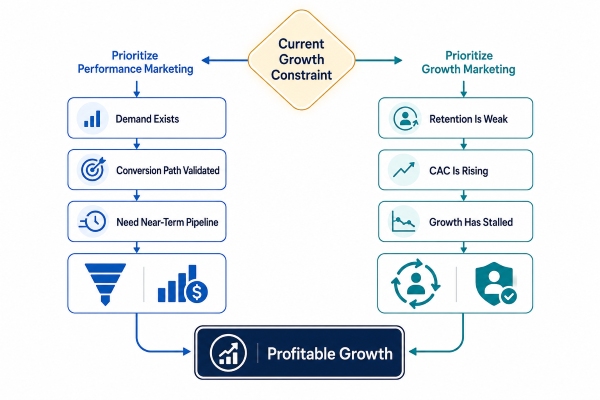
Performance marketing deserves greater emphasis when:
- Demand already exists and the company needs to capture it.
- The offer and conversion journey have been validated.
- Leadership needs predictable pipeline or revenue.
- A product launch requires rapid market feedback.
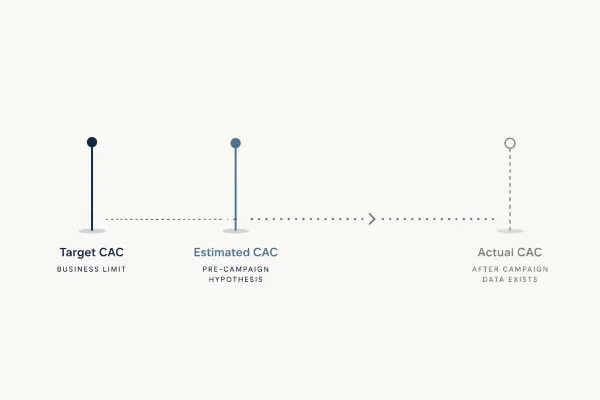
- The business understands contribution margin and acceptable CAC.
- The company wants to test new audiences or markets quickly.
In these situations, paid acquisition can produce fast signals and measurable commercial outcomes.
Growth marketing should receive greater attention when:
- Acquisition is working but retention is weak.
- CAC is rising faster than customer value.
- Customers take too long to reach value.
- The business depends heavily on one paid channel.
- Growth has stalled despite increased media spending.
- Expansion, referrals, or product adoption remain underdeveloped.
Increasing advertising spend will not solve these problems sustainably. The company must improve the surrounding growth system.
Performance Marketing or Growth Marketing: Which Should You Choose?
CMOs can determine the right mix by asking:
- Where is the current growth constraint?
- Is the problem acquisition, conversion, activation, or retention?
- Are reported conversions incremental?
- What happens to marginal CAC as spending increases?
- Would stronger retention materially improve acquisition economics?
- Which team controls the lever that needs to change?
- What result must appear within the next quarter?
- Which improvement should compound over the next year?
The answers should determine the balance between growth and performance marketing. There is no universal percentage split between growth initiatives and performance budgets.
Performance marketing and growth marketing solve different but connected problems. Performance marketing creates accountable acquisition and near-term momentum. Growth marketing improves the complete system that turns acquisition into durable revenue.
The strongest marketing organizations connect both through shared economics, coordinated experimentation, and revenue-level measurement. Thank you for reading this blog, If you want to know more about marketing you can read my other blogs on amin farahani‘s blog.