In digital marketing, many businesses invest time and budget into driving traffic, creating content, or running ads, yet still struggle to turn attention into real business results. This often happens because their efforts are disconnected and lack structure. A funnel provides that structure by organizing how users move from first contact to becoming customers.
before we start if you should know I talked about ‘what digital marketing is‘ in our posts
A digital marketing funnel is not a trend or a buzzword. It is a practical framework that reflects how people think, research, and make decisions online. When businesses understand funnels, they stop relying on luck and start building predictable systems that support growth and scalability.
Why Most Businesses Struggle Without a Funnel?
Without a funnel, marketing activities tend to operate in isolation. Ads send traffic to generic pages, content attracts readers with no follow-up, and leads are contacted without context. This fragmentation leads to wasted budget and missed opportunities because users are not guided properly.
A digital marketing funnel solves this problem by creating a logical flow. Each step prepares the user for the next one, reducing friction and confusion. Businesses that lack this structure often blame channels or tactics, when the real issue is the absence of a clear system.
How Funnels Organize Digital Marketing Efforts
Funnels bring clarity to digital marketing by assigning a purpose to every channel, message, and action. Instead of asking whether an ad or a post “worked,” businesses evaluate how it contributed to moving users forward in the decision process.
This organization improves consistency and efficiency. Teams know what type of message to show at each stage, and performance can be measured more accurately. As a result, marketing becomes intentional rather than reactive.
What Is Digital Marketing Funnel?
To understand them properly, it is important to look beyond diagrams and labels. It represents a structured way of guiding users through a journey that matches how they naturally make decisions online.
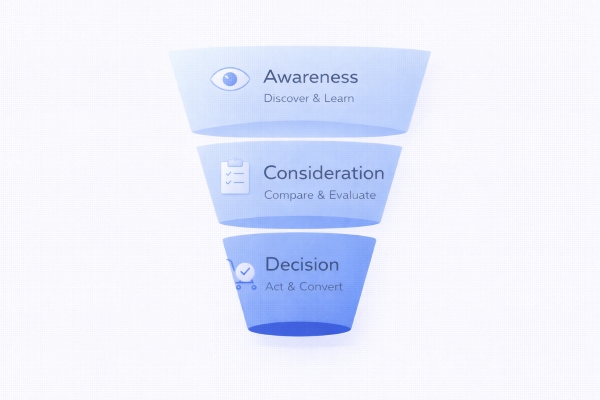
A digital marketing funnel is a step-by-step system that moves people from awareness to action. It starts when someone first discovers a brand and continues until they become a customer or take another meaningful action.
For beginners, the key idea is progression. Users are not expected to trust or buy immediately. Instead, It provides the right information and experience at the right time.
What a Funnel Is and What It Is Not
It is not just a website, a landing page, or a series of emails. These are tools, not the system itself. A funnel is the strategy that connects these elements in a logical sequence.
It is also not a rigid or manipulative process. A well-designed one respects user intent and helps people make informed decisions rather than forcing outcomes.
Why They Exist in Digital Marketing
They exist because people rarely make decisions instantly. Online users compare options, seek reassurance, and look for proof before committing. Ignoring this behavior leads to poor results and low trust.
By acknowledging this reality, funnels allow businesses to align their marketing with human decision-making. This alignment increases relevance, engagement, and conversion rates.
The Logic Behind It
Funnels are rooted in psychology and behavior, not marketing theory alone. They reflect how attention, trust, and motivation develop over time.
How People Actually Make Decisions Online
Online decision-making is rarely linear. Users jump between platforms, read reviews, compare alternatives, and revisit brands multiple times. Each interaction influences perception and readiness.
Funnels account for this complexity by offering multiple touchpoints that reinforce value and credibility. Instead of expecting immediate action, they support gradual decision-making.
Awareness, Consideration, and Decision Explained Simply
At the awareness stage, users realize they have a problem or need. During consideration, they explore solutions and evaluate options. The decision stage is where they choose whether to act.
Each stage requires different messaging. Educational content works best early, while reassurance and proof become critical later. Treating all stages the same reduces effectiveness.
Why One Message Cannot Work for Everyone
A single message cannot address users with different levels of awareness and intent. New visitors need clarity, while returning users need confidence and incentives.
They solve this by segmenting communication. This ensures that users receive messages that match their mindset, improving engagement and trust.
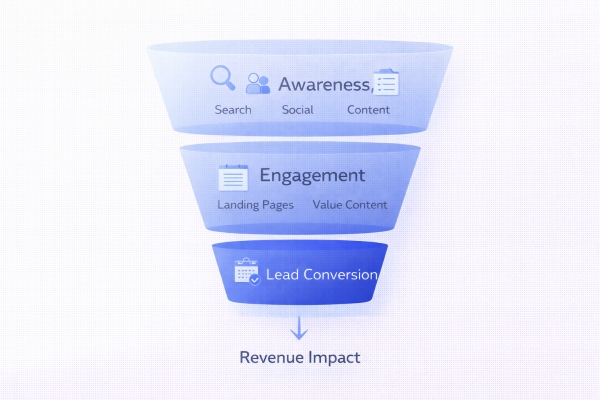
Main Stages of a Digital Marketing Funnel
While they can vary, most follow a common structure that reflects user progression.
Top – Attracting the Right Audience
The top of it focuses on visibility and relevance. The goal is to attract users who are likely to benefit from the product or service.
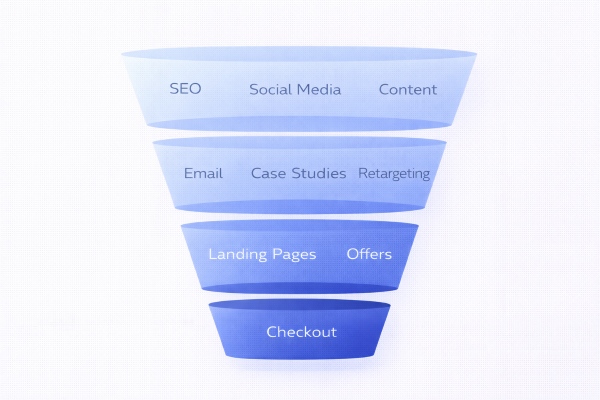
Content, search visibility, and social media often play a key role here. Success at this stage depends on understanding audience needs rather than pushing sales messages.
Middle – Building Trust and Interest
In the middle stage, users are aware but not yet convinced. They seek information, comparisons, and reassurance.
This is where trust is built through educational content, case studies, and engagement. Ignoring this stage often leads to low conversion rates later.
Bottom – Converting Users into Customers
The bottom of it focuses on action. Users here are close to making a decision but may need a final push.
Clear value propositions, social proof, and low-friction experiences are essential at this stage. Small details can make a significant difference in outcomes.
Funnel vs Customer Journey – Understanding the Difference
Funnels and customer journeys are related but not identical concepts.
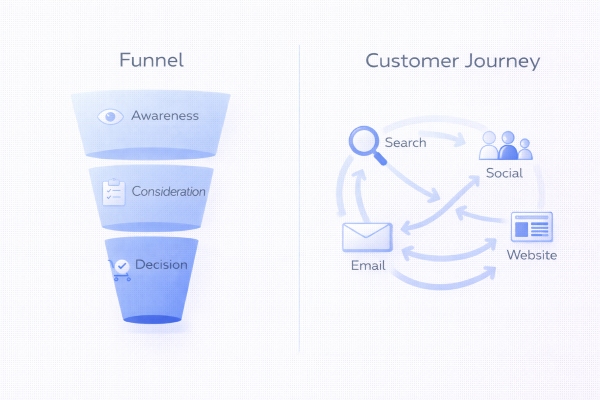
The customer journey represents all interactions a user has with a brand. Funnels simplify this complexity by focusing on key stages that drive decisions.
This simplification helps marketers design and measure strategies more effectively without losing sight of user behavior.
When They Are Useful and When They Are Not
They are useful for structuring marketing and identifying drop-off points. However, they should not ignore the non-linear nature of real behavior.
The most effective strategies combine it’s thinking with journey insights to balance structure and flexibility.
Types of Them in Digital Marketing
Different business models require different funnel structures.
- Lead Generation
Lead generation funnels focus on capturing contact information in exchange for value. They are common in service-based and B2B businesses.
Their success depends on lead quality and follow-up, not just volume.
- Sales for Products and Services
Sales funnels guide users directly toward purchases. They often include product pages, offers, and checkout experiences.
Optimization focuses on reducing friction and increasing confidence.
- Content and Education-Based
Content funnels use education to build trust over time. They are effective for complex or high-consideration offerings.
Consistency and relevance are critical for long-term results.
- Full-Funnel vs Single-Page
Full-funnel strategies involve multiple touchpoints, while single-page funnels compress steps into one experience. Each has advantages depending on audience and offer.
Choosing the right approach requires understanding user intent and behavior.
How They Work in Performance Marketing
Performance marketing brings measurement and accountability into funnel design.
you should read our ‘what is performance marketing‘ post if you don’t know about it
Funnels as Measurable Systems
They allow businesses to track how users move between stages. This visibility helps identify bottlenecks and opportunities.
Measurement transforms them from theory into practical growth systems.
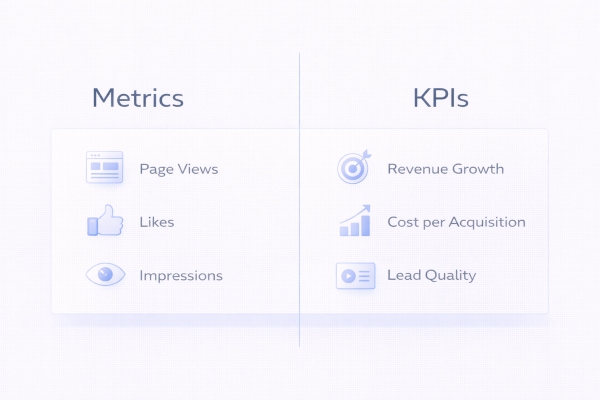
Funnel KPIs and Conversion Rates
Key metrics such as conversion rates and drop-off points reveal performance at each stage. These insights guide optimization efforts.
Focusing on the right metrics prevents misleading conclusions.
If you don’t know about KPIs, I recommend you to read ‘what is KPI in digital marketing‘ blog
Optimizing it with Data
Data-driven optimization improves messaging, targeting, and user experience. Small improvements at each stage compound over time.
This approach supports sustainable and scalable growth.
Common Mistakes Businesses Make
Many of it’s failures stem from strategic misunderstandings.
- Sending All Traffic to One Page
Directing all users to the same page ignores differences in intent. This often leads to poor engagement and low conversions.
Segmented experiences perform better.
- Ignoring Middle level Content
Skipping trust-building stages creates pressure on conversion-focused pages. Users who are not ready often leave.
Middle funnel content reduces resistance.
- Measuring the Wrong Metrics
Focusing only on clicks or traffic hides deeper issues. Metrics should reflect progression and outcomes.
- Expecting Instant Conversions
They require patience and consistency. Unrealistic expectations undermine long-term success.
Do You Need It or a Strategy for It?
Having pages alone is not enough. Pages without strategy lack direction. A funnel connects pages with purpose and flow. This connection is what drives results.
When to Work with a Digital or Performance Marketing Agency or freelancer?
Expert guidance accelerates learning and reduces costly mistakes. Agencies bring experience and systems that support growth.
This partnership is often valuable for scaling businesses.
How Our Performance Marketing Approach Builds High-Converting Funnels
In every Service that we have, such as performace marketing services or digital marketing Our approach focuses on alignment and outcomes.
- Funnel Strategy Based on Business Goals
We design funnels that support real objectives, not vanity metrics. Strategy comes before tactics.
This ensures relevance and efficiency.
- Full-Funnel Optimization and Testing
We continuously test and refine each stage. Optimization is ongoing rather than one-time.
This process drives consistent improvement.
- Transparent Reporting and Revenue Focus
Clear reporting connects marketing efforts to revenue. Transparency builds trust and confidence.
Results guide decisions.
Final Thoughts
It is not a marketing trend but a reflection of how people make decisions online. Businesses that embrace funnel thinking build clarity, consistency, and predictability into their digital marketing efforts. When designed and optimized with a performance mindset, they become powerful growth systems that turn attention into lasting results. if you want to read more about digital marketing you can sign-up your email on amin farahani‘s website.