A channel can report strong ROAS and still add very little new revenue. Branded search and retargeting are common examples: they may receive credit for customers who were already likely to convert. That is the problem incrementality measurement is trying to solve. Instead of asking, “Which channel received the conversion?”, incrementality asks:
“Would this conversion have happened if we hadn’t spent the money?”
The useful process is straightforward: create a credible comparison, measure the additional result caused by advertising, translate that lift into financial metrics such as incremental ROAS, and then decide whether the channel deserves more or less budget. In this blog post of amin farahani, we are going to learn about How to Measure Incrementality in Paid media.
What Incrementality Measures That Attribution Doesn’t
Attribution Gives Credit; Incrementality Tests Causation
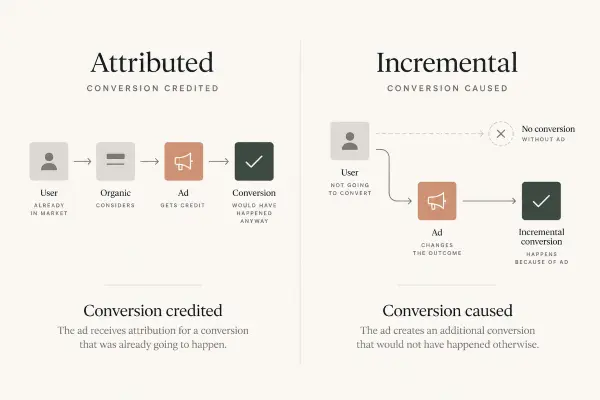
Attribution and incrementality answer different questions. Attribution tries to determine which marketing touchpoint should receive credit for a conversion. Incrementality tries to determine whether marketing actually caused an additional conversion. Suppose someone searches for your company name, clicks a branded search ad, and buys. The ad platform may attribute the purchase to paid search. But that doesn’t tell you whether the customer needed the ad to convert. They may have searched for the brand and clicked the organic result instead. The same issue appears with retargeting. A user who has already visited the pricing page three times may have a high probability of purchasing regardless of whether they see another ad.
So:
Attributed conversion = advertising received credit somewhere in the journey.
Incremental conversion = the conversion happened because of the advertising.
That difference matters when you’re deciding where the next dollar of budget should go.
What Counts as Incremental Lift?
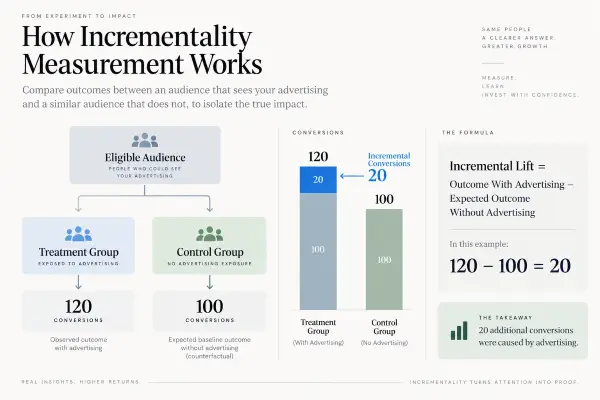
The basic idea can be expressed as:
Incremental lift = Outcome with advertising − Expected outcome without advertising
The difficult part isn’t the subtraction. It’s estimating the second number.You can’t observe the same customer both seeing and not seeing the campaign at the same time. You therefore need a credible counterfactual: a control group that helps estimate what would have happened without the media. Brand-search growth, direct traffic, GA4 trends, and audience growth can all provide useful supporting evidence. But they aren’t automatically proof of incrementality because other factors may have caused the change.
Choose the Right Incrementality Test
The right method depends mostly on what you can realistically hold out from advertising.
| Situation | Best starting method |
|---|---|
| You can randomly withhold ads from some users | User-level holdout or Conversion Lift |
| You can change media exposure by location | Geo-lift or matched-market test |
| Clean experimentation isn’t practical across the full channel mix | MMM supported by periodic experiments |

User-Level Holdout or Conversion Lift
In a user-level holdout test, eligible users are randomly divided into two groups. The treatment group can see the ads. The control group is intentionally withheld from them. You then compare outcomes such as purchases, revenue, customers, or qualified leads between the groups. Because assignment is randomized, this gives you a much stronger basis for estimating causal impact than simply comparing campaign performance before and after launch. Some advertising platforms provide their own Conversion Lift tools that use this logic. Availability and implementation depend on the platform and account.
Geo-Lift or Matched-Market Testing
Sometimes you can’t realistically withhold individual users. In that case, geography can become the unit of experimentation. You might select several comparable regions, continue advertising in the treatment regions, and reduce or remove the channel in the control regions. The important word is comparable. If your treatment regions normally grow faster, have different customer economics, or are affected by another promotion, the difference between the groups may have little to do with the channel you’re testing. Geo tests are especially useful when you’re trying to understand broader channel effects that aren’t captured cleanly at user level.
Where MMM Fits
Media mix modeling can help estimate how different channels contribute to business outcomes over time, particularly when you’re managing a large portfolio of channels.
I would treat MMM as complementary evidence rather than a substitute for a clean experiment. A randomized holdout asks a more direct causal question. MMM is useful when that type of test isn’t always possible.
How to Run a Paid Media Incrementality Test
1. Start With the Budget Decision
Don’t start with a question as broad as:
“Does YouTube work?”
Make the question decision-specific:
“Should we continue spending $50,000 per month on YouTube at the current level?”
That changes how you design the test and which outcome matters.An incrementality study should help you make a decision, not simply generate another dashboard metric.
2. Choose One Primary Business Outcome
Measure something close enough to the business result you’re trying to influence. Depending on the business, that could be:
- Revenue
- Purchases
- New customers
- Qualified leads
Clicks, impressions, and video views can help diagnose campaign delivery, but they usually aren’t strong primary outcomes for an incrementality decision about budget. If you’re deciding whether a channel deserves $50,000 per month, knowing that it generated incremental clicks isn’t enough.
3. Create a Credible Control
The control needs to represent what would reasonably have happened without the advertising.For user-level experiments, randomization does much of this work. For geo tests, you need markets with similar historical behavior and business conditions. You also need to protect the control. If people assigned to the control group are regularly exposed to the campaign anyway, the difference between treatment and control shrinks and the test becomes harder to interpret.
4. Keep the Test Stable
Try not to introduce major changes while the experiment is running. Examples include:
- Large promotions
- Major pricing changes
- Sudden campaign-budget swings
- Regional campaigns affecting only one test group
- Major changes to the conversion funnel
You also need enough time and conversion volume to observe a meaningful difference. That doesn’t mean every marketing decision requires academic-level statistical proof. But there is an important distinction between directional evidence and a result strong enough to justify moving a large amount of budget. An inconclusive result also doesn’t mean the channel has zero incremental value. The experiment may simply be too small, too short, or too noisy to detect the real effect.
5. Calculate Lift, iCPA, and iROAS
Once you have a credible estimate of the control outcome, the basic calculations are simple.
Incremental conversions = Treatment conversions − Expected control conversions
You can express the lift relative to the baseline:
Relative lift = Incremental conversions ÷ Control conversions
If you care about acquisition efficiency:
iCPA = Ad spend ÷ Incremental conversions
And for revenue or conversion value:
iROAS = Incremental conversion value ÷ Ad spend
The key distinction is that iROAS uses the value that advertising actually added, not all revenue attributed to the campaign.
Incrementality Example: Reported ROAS vs Incremental ROAS
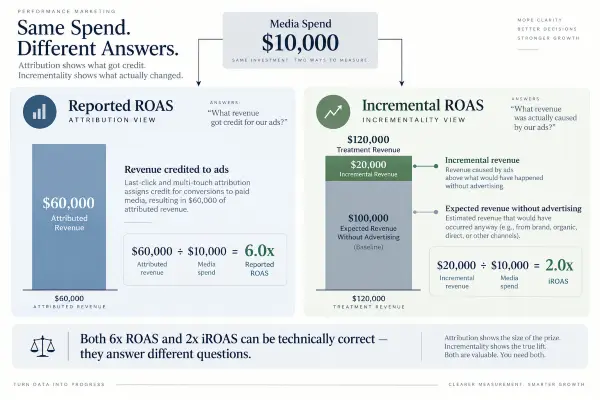
Suppose you’re testing a paid media channel with these results:
- Media spend: $10,000
- Revenue in the treatment group: $120,000
Based on your control group, you estimate that the same audience would have generated $100,000 without the advertising.
So:
Incremental revenue = $120,000 − $100,000 = $20,000
Then:
iROAS = $20,000 ÷ $10,000 = 2.0x
Now suppose the advertising platform reports $60,000 of attributed revenue. Its dashboard ROAS would be:
$60,000 ÷ $10,000 = 6.0x
Both numbers can be technically correct while answering different questions. The 6x figure tells you how much revenue the platform attributed to the campaign. The 2x iROAS estimates how much additional revenue the campaign actually created. For budget planning, that distinction can completely change the decision.
How to Use Incrementality to Adjust Your Channel Mix
This is where incrementality becomes more useful than another reporting exercise.
- If a channel shows high attributed ROAS but weak incrementality, it may be harvesting demand that already exists. Branded search and aggressive retargeting deserve particular scrutiny here.
- If a channel shows modest attributed ROAS but strong incrementality, the opposite may be happening. The channel may create demand that gets credited elsewhere later in the journey.
A strong and profitable iROAS makes a channel a candidate for additional budget. A weak incremental return suggests reducing spend, changing how the channel is used, or testing again under different conditions. An inconclusive result usually calls for caution rather than an immediate budget cut.
This should feed directly back into how you create and rebalance your paid media channel mix. Platform ROAS tells you how the channel is being credited. Incrementality gives you another view of whether the channel deserves its place in the mix.
There is one more tradeoff to remember: incrementality at today’s spend doesn’t tell you exactly what will happen after doubling the budget. Marginal returns can deteriorate as spend increases, so scaling should still be tested rather than assumed.
Read more : How to Create a Paid Media Channel Mix
Common Incrementality Measurement Mistakes
The most common problems aren’t complicated statistical errors. They’re usually design errors. Treating a simple before-and-after comparison as incrementality is one of them. Revenue may have increased after a campaign launched, but seasonality, pricing, promotions, competitor activity, or organic demand could have caused the change.
Other common mistakes include poorly matched control markets, changing major campaign variables during the test, letting control users see the ads, and focusing on attributed conversions instead of business outcomes. I would also avoid interpreting an inconclusive result as proof that the channel doesn’t work. Sometimes the honest answer is simply that the experiment didn’t generate enough evidence.
Attribution helps you understand how campaigns are receiving conversion credit. Incrementality helps you decide whether the channel is actually creating enough additional value to deserve the budget. Once you can separate those two questions, channel-mix decisions become much more grounded in what the media is actually adding to the business. If you need to someone done your advertising campaigns fill out a form on my performance marketing services page.