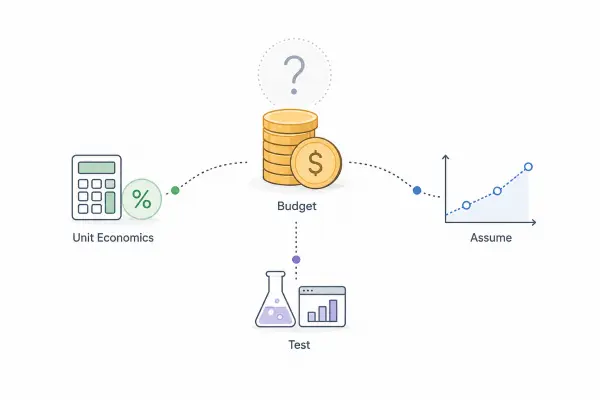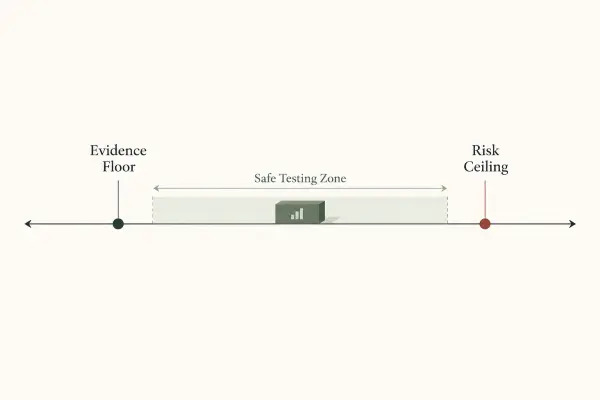
There isn’t a useful universal answer like $500, $1,000, or $50 per day. Your first marketing test budget should be large enough to produce evidence you can actually make a decision from, but small enough that a failed test doesn’t create a serious financial problem. The way I think about it is with two numbers: your evidence floor and your risk ceiling. Your test only makes sense when the amount required to learn something useful fits inside the amount you’re prepared to lose if the hypothesis is wrong. In this blog on amin farahani‘s website I’m going to explain How Much Should You Spend on Your First Marketing Test?.
Your First Test Budget Is Not Your Marketing Budget
Your total marketing budget, your test budget, and your scaling budget are three different things. Your marketing budget is the total amount the business can allocate to generating demand and acquiring customers. Your test budget is the amount you’re willing to spend validating a specific assumption. Your scaling budget comes later, once you have evidence that the acquisition model is working well enough to deserve more money.
Mixing these numbers creates bad decisions. If you have $20,000 available for marketing, that doesn’t mean your first campaign should receive $20,000. But it also doesn’t mean $500 is automatically enough for a meaningful test. If the broader question is how much the business should allocate in the first place, I cover that in my guide to setting a marketing budget without historical data. Here, the narrower question is how much of that budget should be exposed to the first experiment.
Step 1 — Decide What the Test Needs to Prove
Before you calculate spend, define the decision the campaign needs to help you make. For example:
- Can we generate qualified leads below $100?
- Can paid search turn this landing page into booked demos?
- Can this campaign acquire customers below a $400 target CAC?
Those are much better test questions than “Does Google Ads work?” or “Does this creative perform?” A good first marketing test should reduce uncertainty around one important assumption. If you simultaneously change the audience, offer, creative, landing page, pricing, and channel, you may get a result, but you won’t necessarily know what caused it.
Choose the Event That Actually Answers the Question
The conversion event matters because it determines both the cost and the quality of the evidence.
- If you’re testing an ad hook, clicks or engaged visits may be enough to learn something.
- If you’re testing lead generation, raw leads are usually not enough. You probably care about qualified leads.
- If you’re testing acquisition economics, customers or revenue matter far more than CTR.
For a B2B company with a long sales cycle, booked demos or sales-qualified opportunities may be the most practical first decision event. The deeper you go in the funnel, the slower and more expensive the test usually becomes. But the evidence also becomes more useful.
Step 2 — Calculate the Minimum Budget Needed to Learn
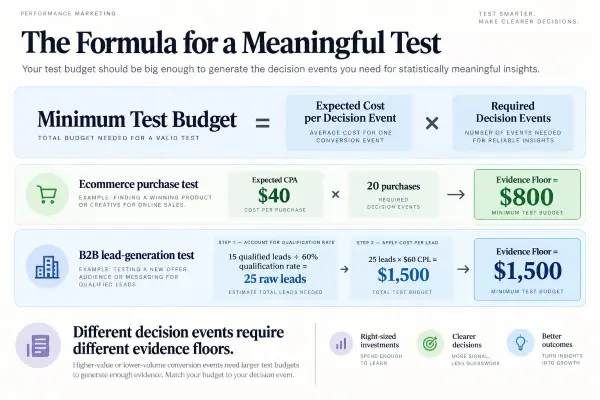
Once you know the event you’re trying to generate, you can estimate the minimum useful test budget.A simple model is:
Minimum test budget = Expected cost per decision event × Required decision events
I would treat this as an evidence floor. It is not a statistically perfect number. It is the amount you believe you need before the campaign can produce enough directional evidence to inform the next decision. The number of required events depends on the question you’re asking. There is no universal rule saying every campaign needs 10, 20, or 100 conversions.
Example: Direct-Response Purchase Test
Suppose you’re running an ecommerce campaign and your planning assumptions suggest an expected CPA of $40. You decide that roughly 20 purchases would give you enough early evidence to evaluate acquisition cost, order quality, and whether the campaign deserves another round of spend. Your initial calculation is:
$40 expected CPA × 20 purchases = $800 test budget
That does not mean 20 purchases create formal statistical significance. It means you’re choosing 20 as the amount of evidence you want before making a directional business decision. If you only spend $100, you may get two or three purchases. That is still data, but it cannot answer the same question with the same confidence.
Example: Lead-Generation Test
Now suppose you’re testing a B2B campaign. Expected CPL is $60, but raw leads are not the result you actually care about. You want approximately 15 qualified leads. You expect around 60% of incoming leads to meet your qualification criteria. So first calculate the number of raw leads required:
15 qualified leads ÷ 60% qualification rate = 25 raw leads
Then calculate the media budget:
25 leads × $60 CPL = $1,500
Your evidence floor is approximately $1,500. This is why a generic “start with $500” recommendation isn’t very useful. If your expected cost per meaningful event is high, $500 may simply be too small to tell you what you need to know.
One more way is that you hire a professional to do this for you, you can book a meeting with me on my performance marketing services page.
Step 3 — Set the Maximum You’re Willing to Lose
The evidence floor tells you what the experiment probably needs. The risk ceiling tells you what the business can responsibly afford. Ask a simple question:
If this campaign fails to produce a scalable acquisition model, how much money am I comfortable losing in exchange for what I learn?
That answer depends on cash flow, runway, other experiments competing for budget, and how expensive a wrong assumption would be. A company with strong cash reserves can tolerate more experimentation than a business operating with two months of runway. The campaign economics may be identical, but the acceptable risk is not. So the basic decision becomes:
Evidence floor ≤ Risk ceiling
If the test needs $1,500 to generate useful evidence and you’re comfortable risking $2,000, the test is financially possible. If it needs $3,000 and you can responsibly risk only $750, you have a problem with the experiment design—not just the budget.
What If the Minimum Useful Test Costs More Than You Can Afford?
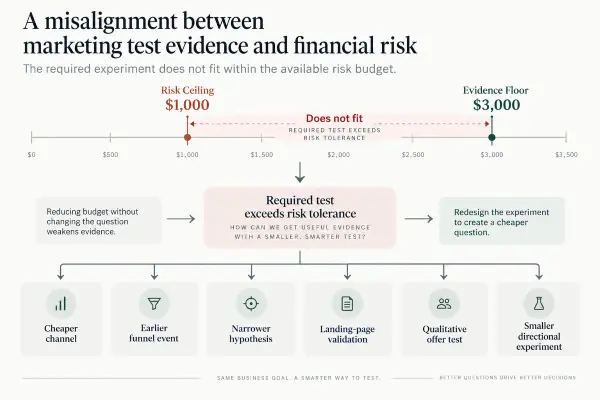
This is where people often make the wrong compromise. Suppose your evidence floor is $3,000, but your risk ceiling is $1,000. Running the exact same test with $1,000 doesn’t magically make it valid. You are simply buying less evidence. That may still be useful, but you need to change what you’re expecting the experiment to prove. You could:
- test a cheaper channel;
- measure an earlier funnel event;
- narrow the audience or hypothesis;
- improve the landing page before buying more traffic;
- validate the offer qualitatively first;
- run a smaller directional test and accept a weaker conclusion.
Sometimes the right answer is simply: you don’t currently have enough budget to test this acquisition hypothesis properly. That doesn’t mean you can’t market. It means you need a cheaper question.
A Worked First Marketing Test Budget
Suppose a B2B company wants to test paid search. The planning assumptions are:
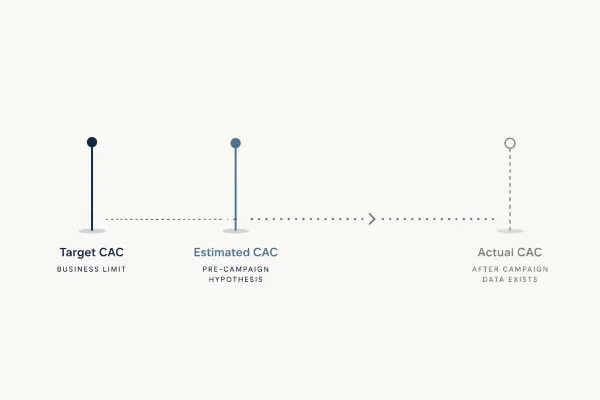
- Target CAC: $600
- Expected CPC: $8
- Landing-page conversion rate: 10%
- Expected CPL: $80
- Qualified-lead rate: 60%
- Desired qualified leads: 15
To generate 15 qualified leads at a 60% qualification rate:
15 ÷ 60% = 25 raw leads
At an $80 CPL:
25 × $80 = $2,000 media budget
So the evidence floor is approximately $2,000. Now suppose the business expects around 20% of qualified leads to become customers. That gives:
15 qualified leads × 20% close rate = 3 customers
The directional expected media CAC would be:
$2,000 ÷ 3 = about $667
That is already above the $600 target CAC. This doesn’t automatically mean the campaign should be rejected. It tells you that the economics are tight. One of the assumptions needs to outperform the base case—perhaps CPL needs to be lower, qualification rate higher, or the sales close rate stronger. Now compare the test with business risk. If the company is comfortable losing up to $2,500 to validate the channel:
$2,000 evidence floor < $2,500 risk ceiling
The test is fundable. If the company can only risk $750, the same experiment isn’t really viable. I would redesign the test instead of pretending $750 can answer a $2,000 question.
Decide Your Stop, Continue, and Scale Rules Before Launch
The worst time to decide what “good enough” means is after you’ve seen the results. Set the decision rules before the campaign starts.
- Stop: the economics clearly fall outside your acceptable range, and there is enough evidence to believe the problem isn’t just noise.
- Continue testing: the result is promising, but you don’t yet have enough evidence to make a scaling decision.
- Scale: the campaign produces enough of the right conversion events, and CAC or CPA fits the business economics.
Do not scale because CTR looks good or CPC is cheaper than expected. Those are useful diagnostics, but the test should be judged on the event it was designed to validate. The useful question isn’t, “What’s the cheapest amount I can spend?”
It’s:
“What’s the cheapest amount I can spend and still learn something that changes my next decision?”
Calculate that evidence floor, compare it with your risk ceiling, and let the result tell you whether to run the test, redesign it, or wait until you can fund it properly.