Marketing frameworks exist to simplify complex decisions, and few models have remained as influential as the 4P of marketing. Even for people who have never studied marketing formally, this framework quietly shapes how products are designed, priced, distributed, and promoted every day. Understanding it helps businesses avoid random tactics and instead build structured, intentional strategies.
In today’s digital-first environment, the principles behind the 4P have not disappeared. Instead, they have evolved. Digital channels, performance data, and changing customer behavior have added new layers to how each element works. This guide explains the model in simple terms and shows how it connects directly to modern digital and performance marketing.
Why the 4P Model Still Matters Today?
Many businesses assume the Four P model is outdated because it was introduced decades ago. In reality, the core logic behind it is timeless. Every business still needs to decide what it offers, how much it costs, where customers can access it, and how people learn about it. These questions exist regardless of technology.
What has changed is execution. Digital platforms allow faster testing, clearer measurement, and more precise targeting. When combined with modern tools, the 4P framework becomes more powerful, not less, because decisions can be validated with real data instead of assumptions.
From Traditional Marketing to Digital-First Strategies
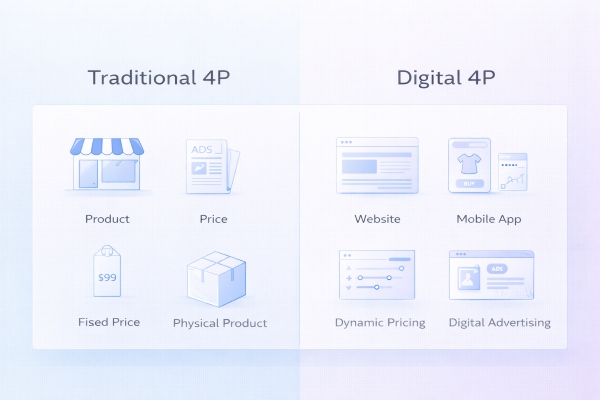
Originally, the 4P model was applied to physical products, physical stores, and mass media advertising. Today, businesses operate in a world of websites, apps, online marketplaces, and paid media platforms. This shift has expanded what each “P” represents and how it is optimized.
Digital-first strategies make the framework more dynamic. Businesses can adjust pricing quickly, change distribution channels instantly, and refine promotion messages based on performance. This flexibility is exactly why understanding the model is still essential.
What Is the 4P of Marketing?
At a foundational level, the 4P of marketing is a framework that helps businesses structure their marketing strategy. It ensures that decisions are aligned and that no critical area is ignored when going to market.
Simple Definition of the Four P for Beginners
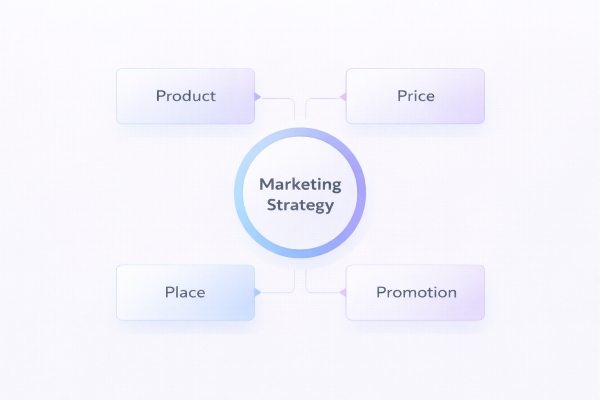
The model consists of four elements: product, price, place, and promotion. Together, they describe what you sell, how much you charge, where customers can access it, and how you communicate its value. Each element influences customer perception and buying decisions.
For beginners, the key takeaway is that marketing is not just advertising. It starts long before promotion and continues after a customer interacts with your brand.
The Origin of the This Marketing Model
The framework was introduced to help businesses bring structure to marketing decisions. At the time, markets were simpler, and distribution channels were limited. Despite that, the model’s logic was strong enough to survive decades of change.
Its longevity comes from its focus on fundamentals. Technology may evolve, but customers still evaluate value through similar lenses, whether they shop in-store or online.
Why Understanding the 4P Is Essential Before Running Any Campaign?
Running campaigns without understanding the 4P often leads to wasted budgets. Promotion cannot fix a poorly defined product, unrealistic pricing, or weak distribution. Many failed campaigns are not advertising problems but strategy problems.
When businesses understand this framework, they can identify gaps early and build campaigns that are aligned with real customer needs and business goals.
Overview of the 4P of Marketing
Each of the four elements plays a distinct role, but they are deeply interconnected. Weakness in one area can reduce the effectiveness of the others.
Product – Solving the Right Problem
A product is not just a physical item or service. It is a solution to a specific problem. In digital environments, this includes user experience, onboarding, and perceived value, not just features.
Businesses that clearly define the problem they solve are better positioned to attract and retain customers.
Price – Perceived Value and Market Position
Pricing communicates more than cost. It signals quality, positioning, and expectations. In digital markets, customers compare options quickly, making pricing strategy even more critical.
A strong pricing decision balances profitability with perceived value and competitive context.
Place – Where and How Customers Find You
Place refers to distribution and access. In digital marketing, this often means websites, platforms, and channels rather than physical locations.
Being present where customers already spend time increases convenience and trust.
Promotion – How You Communicate Value
Promotion includes all communication used to attract and persuade customers. Messaging must align with the product, price, and place to be effective.
Digital channels have made promotion more measurable and more accountable than ever before.
Product in the Digital Marketing Era
Digital transformation has expanded the meaning of “product” far beyond traditional definitions.
Product-Market Fit in Online Businesses
Product-market fit means that a real audience wants what you offer. Digital analytics allow businesses to observe behavior and validate fit faster than before.
Without this alignment, no amount of promotion can produce sustainable results.
Digital Products vs Physical Products
Digital products often evolve continuously through updates and feedback. Physical products rely more on branding, packaging, and post-purchase experience to communicate value.
Both require clarity in positioning and customer expectations.
How User Experience and Branding Shape Product Perception?
In digital environments, user experience is part of the product itself. Slow load times, confusing navigation, or unclear messaging reduce perceived value.
Branding reinforces trust and consistency, influencing how customers judge quality.
Pricing Psychology in Digital Channels
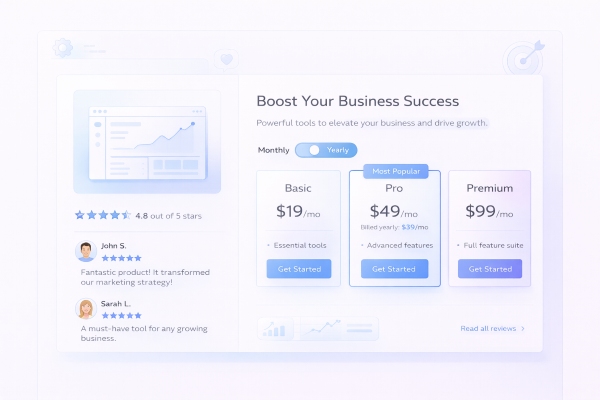
Price is one of the strongest decision triggers in digital environments. Online buyers are highly price-aware. Anchoring, discounts, and bundles influence perception and urgency.
Understanding psychology helps businesses price strategically rather than emotionally.
Dynamic Pricing, Subscriptions, and Freemium Models
Digital models allow flexible pricing structures. Subscriptions and freemium models lower entry barriers while increasing lifetime value.
These approaches require careful tracking and optimization.
How Digital Advertising Impacts Price Sensitivity
Targeted advertising reaches users at different stages of awareness. Messaging can reduce price sensitivity by emphasizing value and outcomes.
Measuring Price Performance with Data
Conversion rates, lifetime value, and churn provide insight into pricing effectiveness. Data replaces guesswork.
What “Place” Means in Modern Digital Marketing
Distribution has expanded dramatically in the digital age. Place now includes websites, apps, search platforms, and social channels. Accessibility and ease of use matter more than physical proximity.
Websites, Marketplaces, Apps, and Social Platforms
Each channel serves different behaviors and expectations. Choosing the right mix improves reach and efficiency.
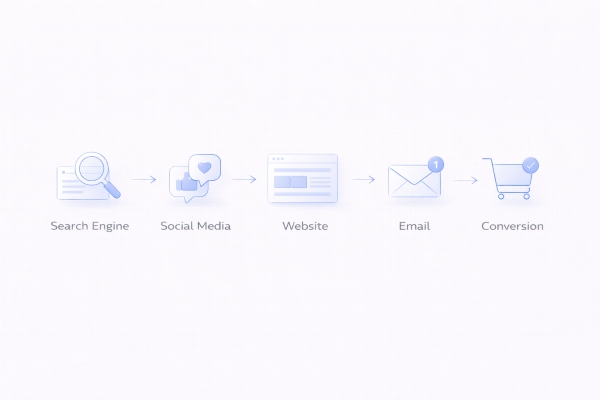
Customers move between channels before converting. Mapping this journey helps remove friction and improve experience.
How Traffic Sources Affect Conversion Rates
Not all traffic behaves the same. Understanding source intent improves performance.
Traditional Promotion vs Digital Promotion
Promotion is where most businesses focus, often too early. Traditional methods prioritize reach, while digital promotion prioritizes relevance and measurability.
Paid Media, Organic Growth, and Performance Channels
Combining paid and organic efforts creates balance between speed and sustainability.
Content, Search, Social, and Email in Promotion Strategy
Each channel serves a role in education, trust-building, and conversion.
Promotion as a Measurable Growth Engine
Performance data transforms promotion into a system that improves over time.
How Our Performance Marketing Approach Applies the 4P in Practice?
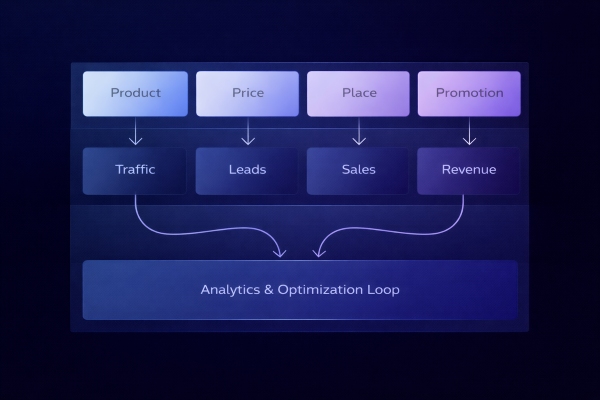
We focus on outcomes, not theory. Strategy First, Channels Second, Foundations come before tactics.
Full-Funnel Optimization Using the 4P Framework, Every stage is aligned and measured. Our Performance marketing service is based on being data-driven. Transparent Reporting and Business-Focused Results, Clarity builds trust and growth.
Final Thoughts
The Four P of marketing remains one of the most useful strategic tools when applied correctly. In a digital environment, its value increases because decisions can be tested, measured, and refined continuously. For businesses that want growth rather than guesswork, combining this framework with professional digital and performance marketing execution creates a clear competitive advantage.